 Z&Z STROTEC
Chucks, Collets & Guide Bush (夾頭 / 筒夾 / 導套)
夾頭、筒夾與導套 · 척 · 콜릿 · 가이드 부시
View interactive version · 完整互動版 · 인터랙티브 버전 →Two Different Systems: Spindle Side and Tool Side
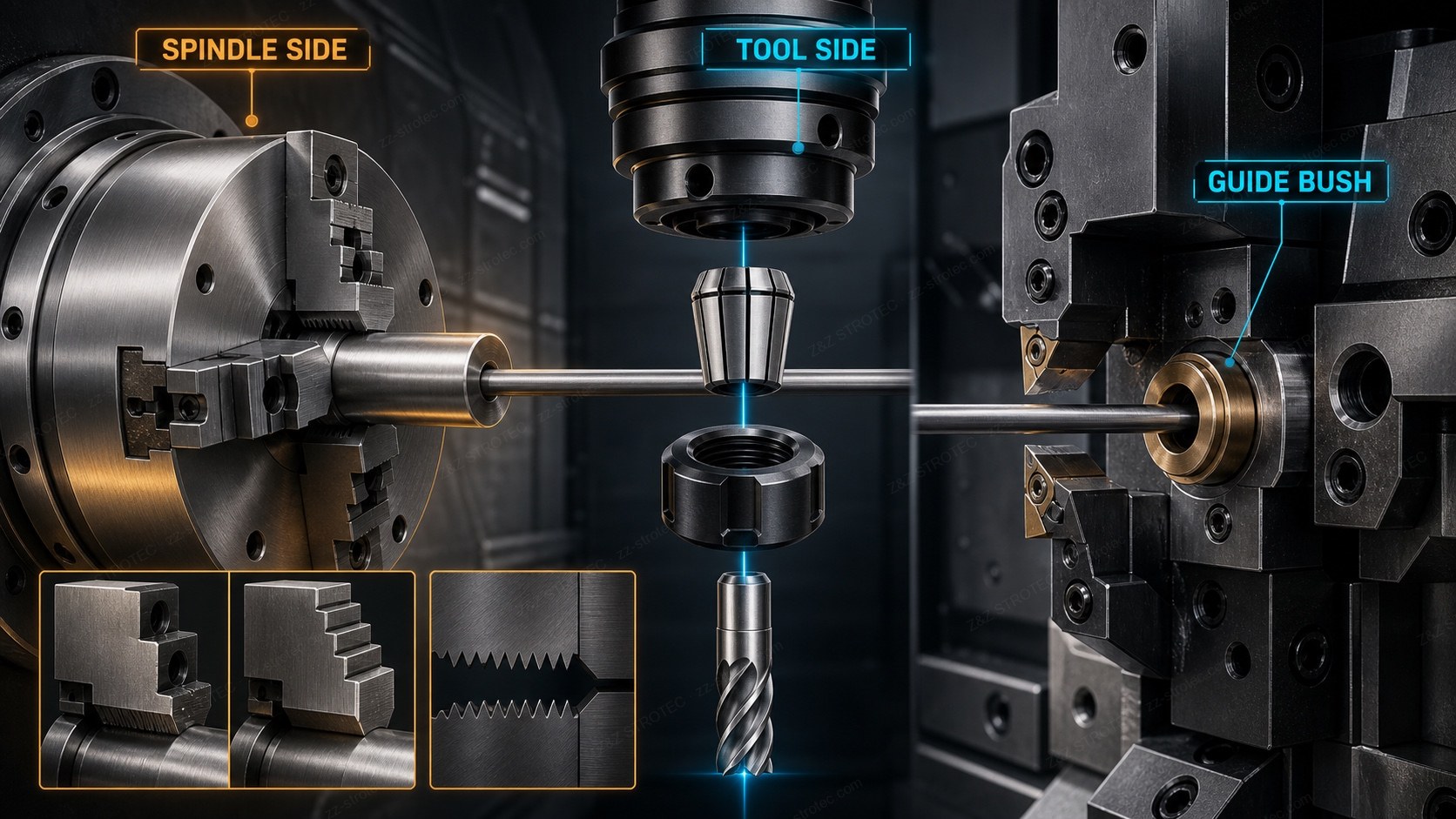
"Collets and chucks" covers two systems that are often confused in an inquiry, and they are not interchangeable:- Spindle side (workholding): the chuck or collet chuck mounted on the spindle nose that grips the workpiece — hydraulic chucks, jaws, collet chucks, face plates.
- Tool side: the collets that hold cutting tools inside live and static holders — the ER system below.
Spindle Nose Interface
The spindle nose decides what will physically mount. Common standards:- A2 series (A2-4, A2-5, A2-6, A2-8, A2-11): short taper location with bolt fixing — the most common form on CNC lathes.
- D1 series (D1-4, D1-6, D1-8): camlock mounting.
- Some machines use a proprietary nose or an integrated spindle.
Hydraulic Chuck Types
- Through-hole (hollow): bar passes through, required for bar work.
- Solid: no through-hole, generally higher gripping force, suited to individual blanks.
- Collet chuck: better concentricity and a short clamping length — suited to small diameters and thin-walled parts.
- Face plate or special fixture: irregular parts, castings, or work needing a locating face.
Jaws
- Soft jaws: bored to suit the part, consumable, best concentricity on the bored diameter.
- Hard jaws: standard stepped jaws for general gripping.
- Serration pitch: commonly 1.5 mm × 60°, 3 mm × 60° or 1/16" × 90°. Jaws with a different pitch will not interchange even when the chuck size matches — this is a frequent ordering error.
Gripping Force and Speed
A chuck carries a maximum rated speed, which is a safety limit rather than a recommended figure. As speed rises, centrifugal force acting on the jaws reduces the actual gripping force, so the force available at working speed can be well below the static value. This matters most on large diameters and heavy parts. High-speed applications should also confirm the chuck's balance requirement.Tool-Side Collets
ER Collet System (Most Common)
ER collets (ER 筒夾) are the most widely used tool clamping system in live tooling. The ER number (ER8, ER11, ER16, ER20, ER25, ER32, ER40) indicates collet outer diameter.- Clamping range: Each collet covers a 1mm range (e.g. ER16 "10" = 9–10mm)
- Runout: Standard ±0.01mm; precision grade ±0.005mm
- Use: Drill chucks in live tools, end mill holders, tap holders
Tapping Collets (攻牙筒夾)
Special collets with torque transmission and axial float for rigid tapping. Required when tapping without synchronized speed control.Guide Bush (導套) — Swiss-Type Lathes
Used in sliding headstock (走心式) lathes. Supports bar stock close to the cutting point to reduce deflection on long/slender workpieces.- Fixed guide bush: Simple, lower cost. Bar must be precision-ground to match bore.
- Rotating guide bush: Rotates with bar — eliminates friction, suitable for non-ground bars.
- Guide bush bore must match bar diameter within 0.01–0.02mm
Spindle Collet Chucks
Swiss lathes and multi-spindle machines use collet chucks at the main spindle for bar feeding. Common types: 5C, 16C, R8, and machine-specific designs.繁體中文
兩個不同的系統:主軸端與刀具端
「夾頭與筒夾」其實涵蓋兩個系統,詢價時最常被混淆,而兩者並不通用:- 主軸端(工件夾持):安裝在主軸鼻端、用來夾持工件的夾頭或筒夾夾頭,包含油壓夾頭、爪、筒夾夾頭與面盤。
- 刀具端:安裝在動力刀座或靜態刀座內、用來夾持刀具的筒夾,也就是下方的 ER 系統。
主軸鼻端規格
主軸鼻端決定夾頭能不能裝上去。常見標準:- A2 系列(A2-4、A2-5、A2-6、A2-8、A2-11):短錐面定位、螺栓固定,是 CNC 車床最常見的形式。
- D1 系列(D1-4、D1-6、D1-8):凸輪鎖定式(camlock)。
- 部分機台使用專用鼻端或整合式主軸。
油壓夾頭型式
- 中空(貫穿):棒料可穿過,棒料連續生產必須使用。
- 中實:不貫穿,夾持力通常較高,適合單件毛胚。
- 筒夾夾頭:同心度較好、夾持長度短,適合小徑與薄壁件。
- 面盤或特殊治具:異形件、鑄件或需要定位面的工件。
爪
- 軟爪:可依工件搪修,屬消耗品,搪修面的同心度最好。
- 硬爪:標準階梯爪,用於一般夾持。
- 爪座齒距:常見 1.5 mm × 60°、3 mm × 60° 或 1/16" × 90°。齒距不同的爪即使夾頭尺寸相同也無法互換,這是常見的訂購錯誤。
夾持力與轉速
夾頭有允許最高轉速,那是安全上限而不是建議值。隨著轉速提高,作用在爪上的離心力會使實際夾持力下降,工作轉速下可用的夾持力可能明顯低於靜態值;加工大直徑或重工件時影響尤其明顯。高轉速應用還應確認夾頭的平衡要求。刀具端筒夾
ER 筒夾系統(最常見)
ER 筒夾是動力刀具中最廣泛使用的刀具夾持系統。ER 編號(ER8、ER11、ER16、ER20、ER25、ER32、ER40)代表筒夾外徑。- 夾持範圍:每支筒夾涵蓋 1mm 範圍(例如 ER16 "10" = 9–10mm)
- 偏擺量:標準 ±0.01mm;精密級 ±0.005mm
- 用途:動力刀具鑽夾頭、端銑刀夾、絲攻夾
攻牙筒夾
具有扭力傳遞及軸向浮動功能的特殊筒夾,用於剛性攻牙。無同步速度控制時攻牙須使用此類型。導套 — 走心式車床
用於走心式(滑動主軸)車床,在靠近切削點處支撐棒料,減少細長工件的撓曲。- 固定式導套:結構簡單、成本較低,棒料須研磨至與內孔匹配。
- 旋轉式導套:隨棒料旋轉,消除摩擦,適用於非研磨棒料。
- 導套孔徑須與棒料直徑匹配,公差 0.01–0.02mm
主軸筒夾夾頭
走心式及多軸機台在主軸處使用筒夾夾頭供棒料送進。常見型式:5C、16C、R8 及機台專用設計。한국어
서로 다른 두 시스템: 주축 측과 공구 측
'콜릿과 척'은 문의 시 자주 혼동되는 두 가지 시스템을 포함하며, 서로 호환되지 않습니다.- 주축 측(공작물 척킹): 주축 노즈에 장착되어 공작물을 잡는 척 또는 콜릿 척 — 유압 척, 조(jaw), 콜릿 척, 페이스 플레이트.
- 공구 측: 라이브 툴·정적 홀더 내부에서 절삭공구를 잡는 콜릿 — 아래의 ER 시스템.
주축 노즈 규격
주축 노즈가 척의 장착 가능 여부를 결정합니다. 일반적인 규격:- A2 시리즈(A2-4, A2-5, A2-6, A2-8, A2-11): 숏 테이퍼 위치 결정 + 볼트 고정. CNC 선반에서 가장 일반적입니다.
- D1 시리즈(D1-4, D1-6, D1-8): 캠락 방식.
- 일부 기계는 전용 노즈나 일체형 주축을 사용합니다.
유압 척의 종류
- 관통형(중공): 봉재가 통과하며 봉재 가공에 필수.
- 솔리드형: 관통되지 않고 파지력이 대체로 높아 단품 소재에 적합.
- 콜릿 척: 동심도가 좋고 파지 길이가 짧아 소직경·박육 부품에 적합.
- 페이스 플레이트·전용 지그: 이형 부품, 주물, 위치 결정면이 필요한 부품.
조(Jaw)
- 소프트 조: 공작물에 맞춰 보링하는 소모품으로 보링면의 동심도가 가장 좋습니다.
- 하드 조: 일반 파지용 표준 단차 조.
- 세레이션 피치: 일반적으로 1.5 mm × 60°, 3 mm × 60°, 1/16" × 90°. 피치가 다르면 척 크기가 같아도 호환되지 않으며, 발주 시 자주 발생하는 오류입니다.
파지력과 회전수
척에는 허용 최고 회전수가 있으며 이는 권장값이 아니라 안전 한계입니다. 회전수가 올라가면 조에 작용하는 원심력이 실제 파지력을 낮추므로, 작업 회전수에서의 파지력은 정지 상태 값보다 상당히 낮을 수 있습니다. 대직경·중량 부품에서 특히 중요합니다. 고속 용도에서는 척의 밸런스 요구사항도 확인하십시오.공구 측 콜릿
ER 콜릿 시스템 (가장 일반적)
ER 콜릿은 라이브 툴링에서 가장 널리 사용되는 공구 클램핑 시스템입니다. ER 번호(ER8, ER11, ER16, ER20, ER25, ER32, ER40)는 콜릿 외경을 나타냅니다.- 클램핑 범위: 각 콜릿은 1mm 범위 커버 (예: ER16 "10" = 9~10mm)
- 런아웃: 표준 ±0.01mm; 정밀 등급 ±0.005mm
- 용도: 라이브 툴의 드릴 척, 엔드밀 홀더, 탭 홀더
탭핑 콜릿 (攻牙筒夾)
토크 전달 및 축방향 플로트 기능이 있는 특수 콜릿으로 리지드 탭핑에 사용. 동기화 속도 제어 없이 탭핑 시 필요.가이드 부시 (導套) — 스위스형 선반
슬라이딩 주축(走心式) 선반에 사용. 절삭 지점 근처에서 봉재를 지지하여 길고 가는 공작물의 처짐을 줄입니다.- 고정식 가이드 부시: 단순 구조, 비용 절감. 봉재를 내경에 맞게 정밀 연삭해야 함.
- 회전식 가이드 부시: 봉재와 함께 회전 — 마찰 제거. 비연삭 봉재에 적합.
- 가이드 부시 내경은 봉재 직경 ±0.01~0.02mm 이내로 맞춰야 함
주축 콜릿 척
스위스형 선반 및 다축 기계는 봉재 이송을 위해 주축에 콜릿 척을 사용합니다. 일반적인 유형: 5C, 16C, R8 및 기계 전용 설계.Next step · 下一步 · 다음 단계
Have a specification in hand?
手上已經有規格了嗎? · 사양이 이미 정해져 있으십니까?
Send us the machine model, the part number or a photo from the floor. We will come back on what is available and what it costs.
把機台型號、零件料號或現場照片寄給我們,我們會回覆供貨狀況與價格。
장비 모델명, 부품 번호 또는 현장 사진을 보내주시면 공급 가능 여부와 가격을 회신드립니다.
장비 모델명, 부품 번호 또는 현장 사진을 보내주시면 공급 가능 여부와 가격을 회신드립니다.
WHY THROUGH Z&Z · 為什麼透過萬洋 · Z&Z를 통하는 이유
Multi-brand selection rather than one factory, spec and compatibility checks in writing, a test cut and inspection at the plant before the machine ships, export documentation, and the same part number still available years later. Installation and after-sales in Korea, Brazil, Switzerland and Argentina run through local agents; for other markets we supply parts and components.
不綁單一工廠的多品牌選型、白紙黑字的規格與相容性確認、出貨前在工廠端試車驗機、出口文件,以及數年後仍拿得到的同一料號。韓國、巴西、瑞士、阿根廷的安裝與售後由在地服務商執行,其他市場我們供應零件與零組件。
단일 공장에 묶이지 않는 다중 브랜드 선정, 문서로 남기는 사양·호환성 확인, 선적 전 공장 시운전과 검사, 수출 서류, 그리고 수년 뒤에도 확보 가능한 동일 품번. 한국·브라질·스위스·아르헨티나의 설치와 애프터서비스는 현지 대리점이 담당하며, 그 외 시장에는 부품을 공급합니다.