 Z&Z STROTEC
CNC Machine RFQ Checklist: 15 Specifications to Send With an Inquiry
CNC 機台詢價清單:RFQ 前應提供的 15 項規格 · CNC 설비 RFQ 체크리스트: 문의 시 보낼 15가지 사양
View interactive version · 完整互動版 · 인터랙티브 버전 →An inquiry that reads only "Please quote one CNC lathe" rarely produces quotations that can be compared with each other. Two lathes that look alike can differ in spindle bore, bar capacity, torque, axis configuration, turret, controller and level of automation. Without workpiece and capacity data a supplier can only keep asking, or quote against general assumptions — which is how a price that looks low at first ends up growing option by option once the real requirement is confirmed. A complete RFQ is not simply a request for a price; it converts the part, the process, the volume, the site and the commercial terms into a machine specification. The 15 items below are what an overseas buyer should prepare, and the article closes with a shorter checklist and template for buyers who only need tooling, workholding or spares.
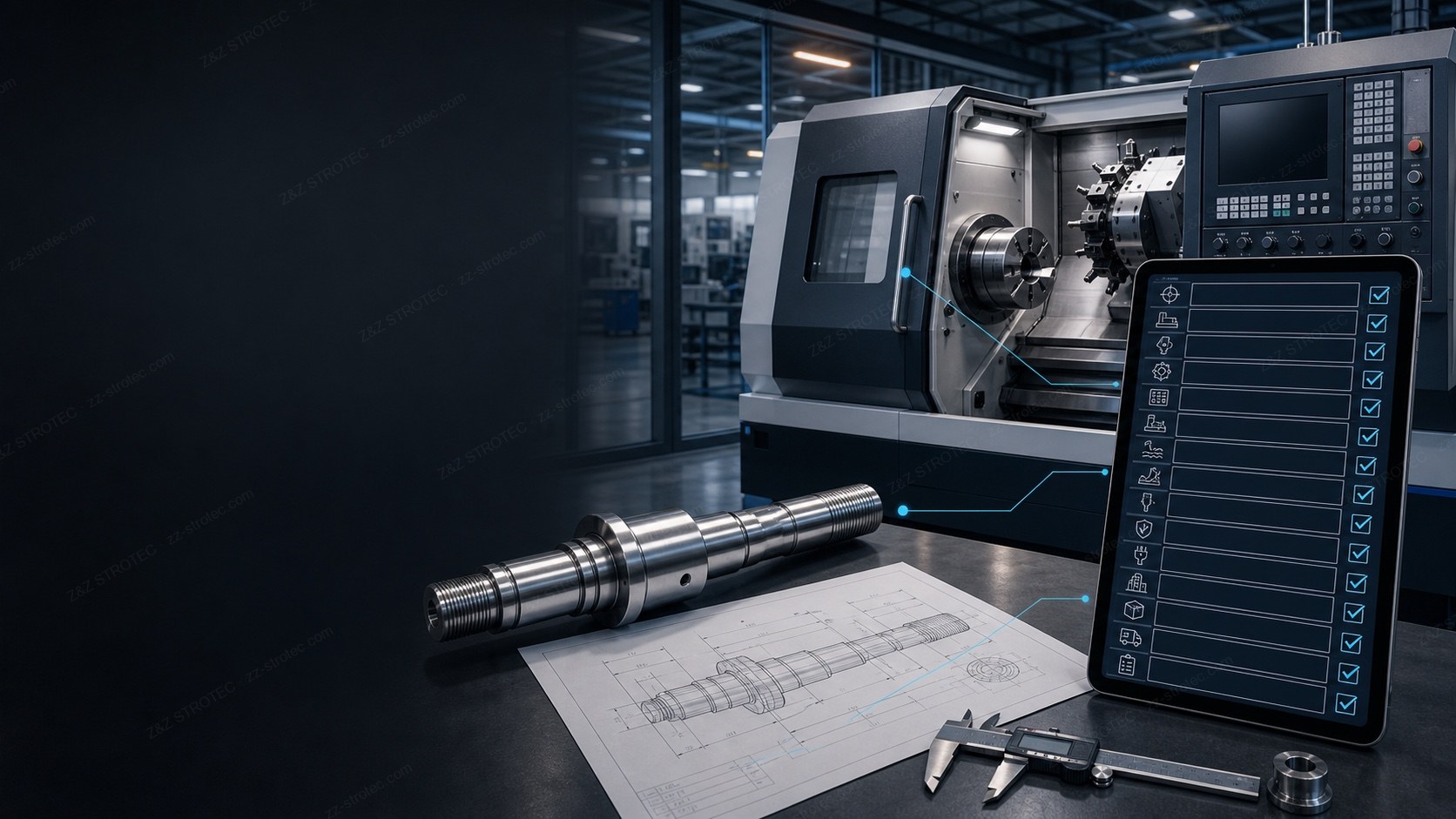
Start With the Part, Not the Machine
The most common ordering problem in a CNC inquiry is naming a machine model before any workpiece data has been shared. A buyer may believe a two-axis lathe is needed, and analysis of the part then shows something else: cross-holes calling for a C axis and live tooling, off-centre features or flats calling for a Y axis, work on both ends suiting a sub-spindle, long small-diameter bar in volume pointing at a Swiss-type machine, or accumulated error from repeated re-clamping justifying a mill-turn centre. It can equally show the opposite — that the volume does not support a complex machine and a standard lathe is the better investment. An effective RFQ therefore starts from what has to be produced, not only from what the buyer intends to buy.
1. Workpiece Information
Provide data for a representative part: 2D drawings, a 3D model in STEP, IGES or Parasolid, photographs of the finished part, maximum outside diameter, length and weight, the main features to be machined, and the critical dimensions and tolerances.
Where there are several products, there is no need to send everything at the start. Choose the part that is largest, most accurate, most complex and highest in volume. If the data is confidential, a simplified drawing with customer names, part numbers and non-essential dimensions removed is enough to begin, with the full version following an NDA.
2. Workpiece Material
Material drives spindle torque, tooling, coolant strategy, chip handling and the estimated machining time. Give the material name and grade, the hardness with its unit (HB, HRC or HV), whether it is heat treated and whether that happens before or after machining, whether there is cast skin, forging scale or an irregular surface, and whether it counts as a difficult-to-cut material.
"Steel" or "stainless steel" is not enough. S45C, SCM440, SUS304, SUS316, 17-4PH and hardened steel differ widely in cutting conditions.
3. Raw Material Form
State whether the stock is round or hexagonal bar, tube, forged blank, casting, sawn billet or a part-machined semi-finished item, and give blank dimensions, weight and the variation between pieces.
For continuous bar work also give bar diameter, bar length, straightness, surface condition and whether an automatic bar feeder is required. Raw material form drives the choice of workholding, spindle bore, chuck, collet, feeder and loading system.
4. Required Machining Operations
List what is to be completed on the machine: OD and ID turning, facing, grooving and parting, threading or tapping, axial drilling, cross drilling, off-centre holes, face or slot milling, angled holes, and any special operation.
If the part needs milling, cross drilling or tapping, say whether it should be finished on one machine in a single set-up. That is what decides whether a C axis, a Y axis, live tool stations or a sub-spindle are required. Operations such as hobbing or slotting normally need a dedicated unit or a second machine rather than a standard lathe, so confirm those separately.
5. Required Accuracy
Mark on the drawing what genuinely matters: dimensional tolerance, coaxiality or runout, roundness, cylindricity, parallelism, perpendicularity, position, and the relationship between features machined at opposite ends.
In practice the positional accuracy of turned parts is specified and measured as circular or total runout (TIR). Where a drawing says "concentricity", state the measurement method and datum as well, so both sides read acceptance the same way. Avoid "high precision" on its own — the supplier needs to know whether the tolerance is ±0.05 mm, ±0.01 mm or tighter. Separate drawing tolerance from the range the process should normally hold, and say which dimensions are 100% inspected and which are sampled.
Positioning accuracy and repeatability on a specification sheet are not the tolerance every part will automatically achieve. Confirm which standard the figures were measured to — ISO 230-2, JIS B 6330 or VDI/DGQ 3441 — because values from different standards are not directly comparable. Real results also depend on tooling, fixturing, material, thermal displacement and the measuring method.
6. Surface Finish
Mark the roughness required on the critical surfaces — Ra 3.2, Ra 1.6 or Ra 0.8 µm, for example — and say what each surface does: a bearing fit, an oil seal contact face, a hydraulic or pneumatic sealing face, a visible surface, or a pre-finish surface before grinding or polishing. Surface finish influences spindle performance, machine rigidity, tooling, cutting parameters, and whether a downstream finishing operation is needed at all.
7. Production Volume
Give the quantity required per day, month or year, the number of shifts, the effective production time per shift, working days per week, the expected product life cycle, and whether volume is likely to grow.
The same part at 100 pieces a month and at 100,000 pieces a month does not lead to the same machine or the same automation. Low volume with high mix usually values changeover speed and flexibility; high volume values cycle time, stability, automatic loading and tool life management.
8. Target Cycle Time
Where a process already exists, give the current cycle time per piece, load and unload time, tool change time, measuring time, the current bottleneck and the improvement you are aiming at.
The most important thing is to define what "cycle time" includes. Some quoted figures count cutting only, excluding loading and unloading, turret indexing, washing, measuring and robot motion. Writing "cycle time per piece, including load and unload" in the RFQ removes that ambiguity.
If there is no cycle time data yet, give the volume and working hours and let the supplier work back to the time available per piece — the takt time, which is a demand-derived rhythm rather than the machine's actual cycle time. For example: 20,000 pieces a month against 400 effective production hours is 1,440,000 seconds divided by 20,000, a takt of about 72 seconds; at an 85% utilisation assumption the cycle time has to come in around 61 seconds. Any cycle time estimate from a supplier should state the tooling, cutting conditions and motion assumptions behind it, and whether it has been proven by an actual test cut.
9. Machine Type
If there is already a direction, say what should be evaluated: a two-axis CNC lathe, a Y-axis lathe, a mill-turn centre, a twin-spindle or twin-turret lathe, a Swiss-type lathe, a vertical lathe, a machining centre, or a special-purpose machine or line.
If it is not yet clear, there is no need to force a choice. Ask the supplier to propose based on part, volume and process, and to explain why. It is also reasonable to ask for two options compared — a standard lathe plus secondary operations against a Y-axis mill-turn machine finishing in one set-up — weighing not only equipment price but labour, work in progress, changeover time, accuracy risk and total cost of ownership.
10. Spindle and Workholding
Confirm the maximum bar diameter, spindle bore, spindle nose designation such as A2-5, A2-6 or A2-8, chuck or collet size, maximum spindle speed, the low-speed torque required, whether a hydraulic chuck, spring collet or special fixture is used, whether a hollow rotating cylinder is needed, whether a sub-spindle picks the part off, and whether the part is easily deformed or needs low clamping force.
Maximum speed is not the only measure. Large-diameter steel work usually depends more on low-speed torque; small aluminium or miniature parts depend more on high-speed capability and thermal stability.
11. Axis and Turret Configuration
Say what may be needed: X and Z as the base axes, C-axis contouring, a Y axis, a sub-spindle, a second turret, live tooling, the number of turret stations, the tool interface (BMT45, BMT55, BMT65, VDI30, VDI40 or other), radial and axial live tool stations, and whether through-tool coolant is required at the holder.
If a tooling concept already exists, a tooling layout or operation sheet is useful. For live tool stations, confirm not only maximum speed but output torque, gear ratio, the duty cycle that can run continuously, direction of rotation, the collet interface such as ER16 to ER32, and coolant pressure — high-speed drilling and heavy milling can call for quite different holders.
12. CNC Controller and Software
Give the preferred controller brand and series — FANUC, Siemens, Mitsubishi, Heidenhain or another — and confirm interface language, program memory, Ethernet or USB data transfer, DNC, MES or ERP connectivity, tool life management, part counting, macro programming, remote monitoring, in-machine measurement and CAD/CAM post-processor compatibility.
Where a factory already runs a large number of one controller, staying on that platform usually helps with training, program management and spare parts stock.
13. Automation and Auxiliary Equipment
State what is required: bar feeder, short bar feeder, gantry loader, articulated robot, vibratory feeder or magazine, parts conveyor, part turning, automatic door, tool breakage detection, in-machine measurement, high-pressure coolant with filtration, mist collection, oil-water separation, chip conveyor and chip cart, coolant temperature control, and a stabiliser or transformer.
"Robot required" on its own is not enough. Give how the raw material is presented, part weight, the gripping position, the cycle time, safety requirements and the boundary of the automation scope. Confirm as well whether the quotation covers the fence, interlocks, grippers, vision, installation and program integration.
14. Destination, Power Supply and Site Conditions
Overseas purchases especially need the final destination country and city, factory voltage, supply frequency at 50 or 60 Hz, the three-phase rating, compressed air pressure and flow, ambient temperature and humidity, altitude, the height of the factory entrance, gangways and ceiling, floor loading and foundation condition, crane or forklift capacity, and any local safety or electrical certification requirement.
Taiwanese builders normally run in-house testing at 220 V/60 Hz and configure export machines to the destination. Where the site runs 480 V/60 Hz or 380 V/50 Hz, the transformer, motors, pumps, control components and certification all have to be settled at the quotation stage rather than after the machine lands.
15. Commercial, Delivery and Acceptance
Finally, state the budget or target price range, the delivery date wanted, the quotation currency, the Incoterms 2020 rule such as EXW, FCA, FOB, CIF or DAP, the destination port or place, payment terms, warranty period, installation and training requirements, spare parts and consumables, FAT and SAT requirements, who supplies test material, tooling and gauges, and the documents and languages needed.
Under Incoterms 2020, FOB, CFR and CIF apply to sea and inland waterway transport only; parts or smaller equipment moving by air or multimodal transport should use FCA, CPT or CIP instead. If an exact budget cannot be shared, at least indicate the positioning — economical standard equipment, mid-range production equipment, or a high-precision or highly automated solution — which avoids proposals far outside the intended investment.
A Thin RFQ and a Workable One
Not enough to quote
We need one CNC lathe for steel parts.
Please send your best price and delivery time.
Enough to start work
We are looking for a CNC turning solution for an SCM440 shaft.
Finished size: O42 x 180 mm.
Raw material: O45 x 185 mm sawn blank, quenched and tempered to HRC 28-32.
Operations: OD turning, grooving, M20 threading, axial drilling.
Critical tolerance: O35 +/-0.01 mm; runout (TIR) 0.015 mm; finish Ra 1.6 um.
Volume: 8,000 pieces per month, two shifts.
Target cycle time: below 120 seconds, including load and unload.
FANUC control preferred. Automatic loading required (sawn blanks, not bar).
Factory power: 380 V, 50 Hz, three phase.
Destination: Bangkok, Thailand. Please quote FOB Taiwan and DAP Bangkok.
FAT with test cutting and an accuracy report is required.
The first inquiry has no part size, material grade, operations, tolerance, volume, power supply or delivery terms, so the supplier can only send a catalogue or an indicative price and cannot confirm the machine is suitable at all. The second may still need discussion, but the supplier can begin evaluating machine type, workholding, tooling, automation and cycle time straight away.
English RFQ Template — Machine
Subject: RFQ for CNC Machine - [Workpiece / Project Name]

1. Workpiece      Part name / finished dimensions / weight / drawing or 3D file
2. Material       Grade / hardness (HB, HRC) / heat treatment
3. Raw material   Bar / tube / casting / forging / sawn blank + dimensions
4. Operations     Turning / milling / drilling / tapping / other
5. Accuracy       Dimensional tolerance / geometric tolerance (runout, TIR)
6. Surface finish Required Ra on which surfaces
7. Volume         Pieces per day, month or year / number of shifts
8. Cycle time     Current / required (including load and unload)
9. Machine type   CNC lathe / Swiss-type / mill-turn / please recommend
10. Spindle       Max bar diameter / spindle nose / chuck or collet / speed, torque
11. Axes, turret  Y-axis / sub-spindle / live tooling / BMT or VDI  (yes / no / recommend)
12. Controller    Preferred brand and model / language / communication
13. Automation    Bar feeder / gantry / robot / parts catcher / CTS / chip conveyor
14. Site          Destination city and country / power supply / air / restrictions
15. Commercial    Delivery date / Incoterm / installation and training / FAT, SAT / budget

Please provide: technical specification, standard and optional equipment lists,
tooling and automation scope, estimated cycle time with assumptions, price and
Incoterm, delivery time, warranty and after-sales scope, installation and
training cost, and recommended spare parts.
Parts and Spares: A Shorter Checklist
Not every inquiry is for a whole machine. More often an existing machine needs additional live tool holders, replacement collets and chucks, a bar feeder added, or common spares put on the shelf. Those inquiries need far less data than a machine purchase, but a few items still decide whether the interface will fit.
Common to all: machine brand, model and year, controller brand and series, a photograph of the machine nameplate, quantity and required date, and whether this is a one-off or a recurring supply.
Live and static tool holders: turret specification (BMT45, BMT55, BMT65, VDI30, VDI40 or other), station number and mounting direction, radial, axial or angular type, gear ratio and maximum speed, required output torque, the clamping interface such as ER16 to ER32, whether through-tool coolant is needed and at what pressure, and the brand and model of the existing holder if this is a replacement.
Chucks, collets and workholding: spindle nose designation (A2-5, A2-6, A2-8 or other), chuck size in inches, through-hole requirement, the rotating cylinder model and current arrangement, collet type (5C, 16C, 22C, R8 or machine-specific), the workpiece diameter range and clamped length, and whether the part is thin-walled.
Bar feeders: the lathe brand and model it works with, spindle centre height and spindle bore, bar diameter range, bar length of 1.2, 3 or 4 m, round or hexagonal stock, whether it has to interface with the existing controller and on which signals, and the space available on site.
Spares: the original part number if known, a photograph of the part nameplate or stamping, the symptom and when it occurs, the current replacement interval, and the safety stock you want to hold.
English RFQ Template — Parts
Subject: Parts Inquiry - [Machine Model] / [Item]

Machine brand / model / year:
Controller:
Item required:      Live tool holder / static holder / collet / chuck /
                    bar feeder / spare part
Turret interface:   BMT or VDI, and station number
Tool interface:     ER size / spindle nose / collet type
Requirement:        Speed, torque or coolant pressure
Original part no.:  If available
Quantity / required delivery date:
Destination city and country / preferred Incoterm:

Photos of the machine nameplate and the existing part are attached.
Five Questions After the Quotation Arrives
1. What is standard and what is optional? Spindle cooling, chip conveyor, mist collection, high-pressure coolant, automatic door, transformer and the tooling package are not always inside the base price.
2. Is the cycle time calculated or proven by a test cut? Ask for the tooling, cutting parameters and loading assumptions behind the figure.
3. Does the quotation cover the whole automation integration? The robot, gripper, fence, vision, programming and on-site commissioning can sit with different parties.
4. What are the FAT and SAT acceptance criteria? Settle the test piece, measuring method, accuracy report and what happens if it fails before the order, not after the machine is built.
5. Who handles overseas installation, warranty and spares? Confirm remote support, on-site service, travel costs, freight on warranty parts, and how critical spares such as controllers, servos and sensors are supplied.
The lowest quotation is not necessarily the lowest total cost. Downtime, productivity, part quality, after-sales response and spare parts availability all feed into what the machine costs over its life.
Need help putting an RFQ together?
Z&Z STROTEC sources CNC machine tools from Taiwan, and supplies live and static tool holders, chucks, collets and bar feeders along with related spares.
Send the part drawing, material, accuracy requirement and estimated volume — or, for a parts inquiry, the machine nameplate and a photograph of the existing part — and we will help structure the RFQ, confirm the specifications that matter, and match it to a suitable Taiwanese builder or supplier.
一封只寫「Please quote one CNC lathe」的詢價信,通常無法得到可以互相比較的報價。外觀相似的兩台車床,主軸通孔、棒材能力、扭矩、軸向配置、刀塔、控制器與自動化程度都可能不同。供應商若缺少工件與產能資料,只能反覆追問或依一般假設報價——這也是為什麼一開始看起來很低的價格,在需求確認後往往必須不斷增加選配。完整的 RFQ 不只是詢問價格,而是把工件、製程、產能、廠務與商務條件轉換為清楚的機台採購規格。以下是海外買家建議準備的 15 項資料,文末另附一份零件、刀座與備品的短版清單與英文範本。
先談工件,再談機台
CNC 詢價常見的順序問題,是還沒提供工件資料就先指定機台型號。分析工件後可能發現需要 C 軸與動力刀具、Y 軸、副主軸,或更適合走心式與車銑複合機;也可能發現產量不足以支撐複雜機型,標準車床反而更符合投資效益。有效的 RFQ 從「要生產什麼」開始,而不只是從「想買什麼」開始。
1. 工件資料
請提供代表性工件的 2D 圖、3D 模型(STEP、IGES 或 Parasolid)、成品照片、最大外徑與長度重量、主要加工特徵及關鍵公差。產品多樣時不必一次提供全部,先選尺寸最大、精度最高、加工最複雜、產量最高的那一件。涉及保密可先送移除客戶名稱與料號的簡化圖,簽 NDA 後再補完整版。
2. 工件材質
材質直接影響主軸扭矩、刀具、冷卻方式、切屑處理與預估加工時間。請提供材料名稱與牌號、硬度(註明 HB/HRC/HV)、是否熱處理及在加工前或後、是否含鑄皮鍛皮或不規則表面、是否屬難切削材。只寫「Steel」或「Stainless Steel」不夠,S45C、SCM440、SUS304、SUS316、17-4PH 與淬硬鋼的加工條件差異很大。
3. 原料形式
請說明原料是圓棒或六角棒、管材、鍛造毛胚、鑄件、鋸切料,或已部分加工的半成品,並提供毛胚尺寸、重量與尺寸變動範圍。棒料連續生產還需提供棒徑、棒長、直線度、表面狀態,以及是否需要自動送料機。原料形式會影響夾持方式、主軸通孔、夾頭、筒夾、送料機與上下料系統的選擇。
4. 加工工序
請列出預計在機台上完成的工序:內外徑車削、端面、切槽切斷、車牙攻牙、軸向與側面鑽孔、偏心孔、銑面銑槽、斜孔及其他特殊加工。若需要銑削、側鑽或攻牙,請說明是否希望同一台機器、同一次裝夾完成——這會決定是否需要 C 軸、Y 軸、動力刀座或副主軸。滾齒、插削這類加工通常需要專用單元或另一台設備,請另行確認。
5. 精度要求
請在圖面上標示真正重要的項目:尺寸公差、同軸度或圓偏擺、真圓度、圓柱度、平行度、垂直度、位置度,以及兩端加工特徵的相對精度。車削件的相對位置精度實務上以圓偏擺或總偏擺(TIR)標註與量測;圖面若寫 concentricity,建議同時說明量測方式與基準。不要只寫「High Precision」,供應商需要知道是 ±0.05 mm、±0.01 mm 還是更嚴格。規格書上的定位精度與重複定位精度,不等於每個工件都能自動達到相同公差;並請確認數值是依 ISO 230-2、JIS B 6330 或 VDI/DGQ 3441 量測,不同標準不能直接比較。
6. 表面粗糙度
請標示關鍵表面的粗糙度要求,例如 Ra 3.2、Ra 1.6 或 Ra 0.8 μm,並說明該表面屬於軸承配合面、油封接觸面、液壓或氣壓密封面、外觀面,或研磨拋光前的預加工面。表面粗糙度會影響主軸性能、機台剛性、刀具配置、切削參數,也可能影響是否需要後續精加工設備。
7. 產量需求
請提供每日/每月/每年需求量、班數、每班有效生產時間、每週工作天數、預估產品生命週期,以及未來產量是否可能增加。同一工件每月 100 件與每月 100,000 件,所需機台與自動化方案不會相同:少量多樣通常重視換線速度與彈性,大量生產則重視加工時間、穩定性、自動上下料與刀具壽命管理。
8. 目標單件加工時間
若已有現行製程,請提供目前單件加工時間、上下料時間、換刀時間、量測時間、瓶頸與期望改善目標。最重要的是確認「Cycle Time」包含哪些內容——有些報價只算切削,不含上下料、刀塔分度、清洗、量測與機械手動作,建議在 RFQ 直接寫明「單件加工時間,含上下料」。若沒有節拍資料,可提供產量與工時讓供應商反推 Takt Time(依需求量換算的生產節奏,與機台實際加工時間是兩回事):例如每月 20,000 件、有效生產 400 小時 = 1,440,000 秒 ÷ 20,000 ≈ Takt 72 秒;以 85% 稼動率估算,單件加工時間需控制在約 61 秒以內。
9. 預計機型
若已有初步方向,可說明希望評估兩軸車床、Y 軸車床、車銑複合機、雙主軸或雙刀塔車床、走心式、立式車床、加工中心或專用機。不確定時不必勉強指定,可請供應商依工件、產量與製程提出建議並說明理由。也可要求比較兩種方案,例如標準車床加二次加工 vs. Y 軸複合機一次裝夾完成;比較時不應只看設備價格,也要納入人力、在製品、換機時間、精度風險與總持有成本。
10. 主軸與夾持需求
請確認最大棒徑、主軸通孔、主軸鼻端規格(如 A2-5/A2-6/A2-8)、夾頭或筒夾尺寸、最高主軸轉速、低速扭矩需求、使用液壓夾頭或彈簧筒夾或特殊治具、是否需要中空油壓缸、是否以副主軸接料,以及工件是否易變形或需低夾持力。最高轉速並非唯一指標:加工大直徑鋼件通常更重視低速扭矩,小徑鋁件或微型零件則更重視高速能力與熱穩定性。
11. 軸向與刀塔配置
請說明可能需要的配置:X/Z 基本軸、C 軸輪廓控制、Y 軸、副主軸、第二刀塔、動力刀具、刀塔刀位數、刀具介面(BMT45/BMT55/BMT65、VDI30/VDI40 等)、徑向與軸向動力刀座,以及刀座是否需要內冷。若已有刀具配置構想,可提供 Tooling Layout 或加工程序表。動力刀座不只確認最高轉速,還要確認輸出扭矩、齒輪比、可連續運轉的工作週期、旋轉方向、筒夾介面(ER16–ER32)與內冷壓力。
12. 控制器與軟體需求
請提供偏好的控制器品牌與系列(FANUC、Siemens、Mitsubishi、Heidenhain 或其他),並確認操作介面語言、程式記憶容量、Ethernet/USB 傳輸、DNC/MES/ERP 連線需求、刀具壽命管理、工件計數、巨集程式、遠端監控、機內量測與 CAD/CAM 後處理器相容性。工廠若已有大量相同控制器,延續既有平台通常有助於人員訓練、程式管理與備品庫存。
13. 自動化與周邊設備
請說明是否需要棒材送料機、短棒送料機、龍門式上下料、多軸機械手臂、振動盤或料倉、成品輸送帶、工件翻轉、自動門、刀具破損檢測、機內量測、高壓冷卻與過濾、油霧回收、油水分離、切屑輸送機與集屑車、冷卻液溫控、穩壓器或變壓器。不要只寫「Robot Required」——請提供原料擺放方式、工件重量、夾取位置、目標加工時間、安全規範與自動化範圍界線,並確認報價是否包含圍籬、互鎖、手爪、視覺系統、安裝與程式整合。
14. 目的地、電力與廠務條件
海外採購尤其需要提供最終交機國家與城市、工廠電壓、電源頻率(50 或 60 Hz)、三相電源規格、壓縮空氣壓力與流量、環境溫濕度、海拔、廠房入口與走道天花板高度、地板承重與地基條件、吊車或堆高機能力,以及當地安全與電氣認證需求。台灣工具機廠內測試多以 220 V/60 Hz 進行,出口機依目的地重新配置;若現場為 480 V/60 Hz 或 380 V/50 Hz,變壓器、馬達、幫浦、控制元件與認證都必須在報價階段確認,而不是等機台到廠才處理。
15. 商務、交期與驗收條件
最後請說明預算或目標價格區間、希望交期、報價幣別、Incoterms 2020 條件(EXW、FCA、FOB、CIF、DAP 等)、目的港或交貨地點、付款方式、保固期限、安裝與教育訓練需求、備品與耗材、FAT 與 SAT 要求、試切材料刀具量具由誰提供,以及所需文件與語言。Incoterms 2020 中 FOB、CFR、CIF 僅適用海運及內陸水路;零件或小型設備走空運或多式聯運應改用 FCA、CPT 或 CIP。不便提供精確預算時,至少說明採購定位(經濟型標準設備、中階量產設備、高精度或高自動化方案),可避免提出與投資規劃差距過大的方案。
資料不足與較完整的詢價
Not enough to quote
We need one CNC lathe for steel parts.
Please send your best price and delivery time.
Enough to start work
We are looking for a CNC turning solution for an SCM440 shaft.
Finished size: O42 x 180 mm.
Raw material: O45 x 185 mm sawn blank, quenched and tempered to HRC 28-32.
Operations: OD turning, grooving, M20 threading, axial drilling.
Critical tolerance: O35 +/-0.01 mm; runout (TIR) 0.015 mm; finish Ra 1.6 um.
Volume: 8,000 pieces per month, two shifts.
Target cycle time: below 120 seconds, including load and unload.
FANUC control preferred. Automatic loading required (sawn blanks, not bar).
Factory power: 380 V, 50 Hz, three phase.
Destination: Bangkok, Thailand. Please quote FOB Taiwan and DAP Bangkok.
FAT with test cutting and an accuracy report is required.
第一封缺少工件尺寸、材質牌號、加工內容、公差、產量、電力與交貨條件,供應商只能提出型錄或參考價格,無法確認機台是否適用。第二封仍可能需要進一步討論,但供應商已能開始評估機型、夾持、刀具、自動化與加工時間。
英文 RFQ 範本:整機
Subject: RFQ for CNC Machine - [Workpiece / Project Name]

1. Workpiece      Part name / finished dimensions / weight / drawing or 3D file
2. Material       Grade / hardness (HB, HRC) / heat treatment
3. Raw material   Bar / tube / casting / forging / sawn blank + dimensions
4. Operations     Turning / milling / drilling / tapping / other
5. Accuracy       Dimensional tolerance / geometric tolerance (runout, TIR)
6. Surface finish Required Ra on which surfaces
7. Volume         Pieces per day, month or year / number of shifts
8. Cycle time     Current / required (including load and unload)
9. Machine type   CNC lathe / Swiss-type / mill-turn / please recommend
10. Spindle       Max bar diameter / spindle nose / chuck or collet / speed, torque
11. Axes, turret  Y-axis / sub-spindle / live tooling / BMT or VDI  (yes / no / recommend)
12. Controller    Preferred brand and model / language / communication
13. Automation    Bar feeder / gantry / robot / parts catcher / CTS / chip conveyor
14. Site          Destination city and country / power supply / air / restrictions
15. Commercial    Delivery date / Incoterm / installation and training / FAT, SAT / budget

Please provide: technical specification, standard and optional equipment lists,
tooling and automation scope, estimated cycle time with assumptions, price and
Incoterm, delivery time, warranty and after-sales scope, installation and
training cost, and recommended spare parts.
以上為整機採購的英文 RFQ 範本,可直接複製填寫後寄出。填得越完整,越能取得可互相比較的報價。
零件、刀座與備品的詢價清單
並非每次詢價都是整機。更常見的是既有機台要補動力刀座、更換筒夾與夾頭、加裝送料機,或準備常用備品。這類詢價的資料需求比整機少很多,但仍有幾項決定介面能否相容。共通:機台品牌/型號/年份、控制器、銘牌照片、數量與需求時程、一次性或定期補充。刀座:刀塔規格(BMT45/55/65、VDI30/40)、刀位與安裝方向、軸向或徑向或角度型、齒輪比與最高轉速、輸出扭矩、夾持介面(ER16–ER32)、是否需要內冷及壓力、現有刀座品牌型號。夾頭筒夾:主軸鼻端(A2-5/6/8)、夾頭尺寸、通過孔、油壓缸型號與現有配置、筒夾型式(5C/16C/22C/R8 或機台專用)、工件外徑範圍與夾持長度、是否薄壁。送料機:搭配車床型號、主軸中心高與通孔、棒徑範圍、棒長(1.2/3/4 m)、圓棒或六角棒、是否需與控制器介接及訊號、現場空間。備品:原廠料號、銘牌照片、故障現象、更換週期、希望的安全庫存。
英文詢價範本:零件與備品
Subject: Parts Inquiry - [Machine Model] / [Item]

Machine brand / model / year:
Controller:
Item required:      Live tool holder / static holder / collet / chuck /
                    bar feeder / spare part
Turret interface:   BMT or VDI, and station number
Tool interface:     ER size / spindle nose / collet type
Requirement:        Speed, torque or coolant pressure
Original part no.:  If available
Quantity / required delivery date:
Destination city and country / preferred Incoterm:

Photos of the machine nameplate and the existing part are attached.
零件與備品的短版範本。欄位少、填寫門檻低,附上機台銘牌與現有零件照片通常就足以開始確認規格。
收到報價後建議確認的五個問題
1. 哪些是標準配備、哪些是選配?主軸冷卻、切屑輸送機、油霧回收、高壓冷卻、自動門、變壓器與刀具包不一定含在基本價。2. 加工時間是計算值還是實際試切結果?要求列出刀具、切削參數與上下料假設。3. 報價是否包含完整自動化整合?手臂本體、手爪、圍籬、視覺、程式與現場調試可能由不同廠商負責。4. FAT 與 SAT 的允收標準是什麼?應在下單前確認測試工件、量測方法、精度報告與未通過時的處理。5. 海外安裝、保固與備品由誰負責?確認遠端支援、現場服務、差旅費、保固零件運費及控制器伺服感測器等關鍵備品的供應方式。最低報價不一定代表最低總成本。
需要協助整理 RFQ?
Z&Z STROTEC 供應台灣 CNC 工具機,以及動力刀座、靜態刀座、夾頭、筒夾、送料機與相關備品。
請提供工件圖面、材質、精度要求與預估產量;若是零件詢價,請提供機台銘牌與現有零件照片。我們會協助整理 RFQ、確認關鍵規格,並媒合合適的台灣製造廠或供應商。
"Please quote one CNC lathe"만 적힌 문의로는 서로 비교 가능한 견적을 받기 어렵습니다. 겉모습이 비슷한 두 선반도 주축 관통 구멍, 봉재 능력, 토크, 축 구성, 터렛, 컨트롤러, 자동화 수준이 다를 수 있습니다. 공작물과 생산량 자료가 없으면 공급자는 계속 되묻거나 일반적인 가정으로 견적할 수밖에 없고, 그래서 처음에 낮아 보이던 가격이 요구사항 확정 후 옵션으로 계속 늘어납니다. 완전한 RFQ는 단순한 가격 문의가 아니라 부품·공정·물량·현장·상거래 조건을 기계 사양으로 옮기는 작업입니다. 아래 15개 항목이 해외 구매자가 준비할 내용이며, 글 말미에는 공구·척킹·예비품만 필요한 경우를 위한 단축 체크리스트와 양식을 실었습니다.
부품부터, 기계는 그다음
CNC 문의에서 가장 흔한 순서 문제는 공작물 자료 없이 기계 모델부터 지정하는 것입니다. 부품을 분석하면 C축과 라이브 툴, Y축, 부주축이 필요하거나 스위스형·복합기가 더 적합할 수 있고, 반대로 생산량이 복잡한 기종을 뒷받침하지 못해 표준 선반이 더 나은 투자일 수도 있습니다.
1. 공작물 정보
대표 부품의 2D 도면, STEP·IGES·Parasolid 3D 모델, 완성품 사진, 최대 외경·길이·중량, 주요 가공 형상, 핵심 공차를 제공해 주십시오. 품목이 많다면 가장 크고 정밀하며 복잡하고 물량이 많은 부품부터 선택하십시오. 기밀이라면 고객명·품번을 지운 간이 도면으로 시작하고 NDA 후 전체 버전을 보내면 됩니다.
2. 공작물 재질
소재는 주축 토크, 공구, 절삭유, 칩 처리, 예상 가공 시간을 좌우합니다. 재질명과 강종, 경도(HB·HRC·HV 단위 명기), 열처리 여부와 가공 전후 시점, 주물 스킨·단조 스케일 유무, 난삭재 여부를 알려 주십시오. 'Steel'이나 'Stainless Steel'만으로는 부족합니다.
3. 소재 형태
환봉·육각봉, 튜브, 단조 소재, 주물, 절단 소재, 반가공품 중 무엇인지와 소재 치수·중량·편차를 알려 주십시오. 봉재 연속 가공이라면 봉재 지름·길이·직진도·표면 상태와 자동 바 피더 필요 여부도 필요합니다. 소재 형태가 척킹, 주축 관통 구멍, 척·콜릿, 피더, 로딩 시스템 선택을 좌우합니다.
4. 필요한 가공 공정
기계에서 완료할 공정을 나열해 주십시오. 내외경 선삭, 단면, 홈·절단, 나사·탭, 축방향·측면 드릴링, 편심 구멍, 밀링, 경사 구멍 등입니다. 밀링·측면 드릴링·탭이 필요하다면 한 대에서 한 번의 척킹으로 끝낼지 알려 주십시오. 이것이 C축·Y축·라이브 툴·부주축 필요 여부를 결정합니다.
5. 요구 정밀도
도면에 실제로 중요한 항목을 표시해 주십시오. 치수 공차, 동축도 또는 런아웃, 진원도, 원통도, 평행도, 직각도, 위치도, 양단 형상 간 상대 정밀도입니다. 선삭 부품의 위치 정밀도는 실무상 원주·전체 런아웃(TIR)으로 표기·측정합니다. 'High Precision'만으로는 부족하며 ±0.05 mm인지 ±0.01 mm인지 명시해야 합니다. 사양서의 위치결정 정밀도·반복 정밀도는 모든 부품이 자동으로 달성하는 공차가 아닙니다. ISO 230-2, JIS B 6330, VDI/DGQ 3441 중 어느 기준으로 측정했는지도 확인하십시오.
6. 표면 조도
핵심 면의 조도 요구(Ra 3.2, Ra 1.6, Ra 0.8 µm 등)를 표시하고, 해당 면이 베어링 끼워맞춤면인지 오일 실 접촉면인지 유압·공압 실링면인지 외관면인지 연삭·연마 전 예비 가공면인지 알려 주십시오. 조도는 주축 성능, 기계 강성, 공구 구성, 절삭 조건, 후공정 설비 필요 여부에 영향을 줍니다.
7. 생산 물량
일·월·연 소요량, 교대 수, 교대당 실가동 시간, 주당 근무일, 예상 제품 수명주기, 향후 물량 증가 가능성을 알려 주십시오. 같은 부품이라도 월 100개와 월 100,000개는 필요한 기계와 자동화가 다릅니다. 다품종 소량은 셋업 속도와 유연성을, 대량 생산은 가공 시간·안정성·자동 로딩·공구 수명 관리를 중시합니다.
8. 목표 단품 가공 시간
기존 공정이 있다면 현재 단품 가공 시간, 착탈 시간, 공구 교환 시간, 측정 시간, 병목, 목표 개선치를 알려 주십시오. 가장 중요한 것은 'Cycle Time'에 무엇이 포함되는지 정의하는 것입니다. 절삭만 계산하고 착탈·터렛 인덱싱·세척·측정·로봇 동작을 제외한 견적도 있습니다. 자료가 없다면 물량과 가동 시간을 주고 택트 타임을 역산하게 하십시오. 월 20,000개, 유효 400시간이면 1,440,000초 ÷ 20,000 ≈ 택트 72초이고, 가동률 85% 가정 시 가공 시간은 약 61초 이내여야 합니다.
9. 예상 기종
방향이 있다면 2축 선반, Y축 선반, 복합 가공기, 트윈 스핀들·트윈 터렛, 스위스형, 수직 선반, 머시닝 센터, 전용기 중 무엇을 검토할지 알려 주십시오. 불확실하다면 억지로 지정할 필요는 없으며, 부품·물량·공정을 근거로 제안과 그 이유를 요청하십시오. 두 안(표준 선반+2차 가공 vs. Y축 복합기 원척킹)을 비교 요청하는 것도 합리적입니다.
10. 주축과 척킹
최대 봉재 지름, 주축 관통 구멍, 주축 노즈 규격(A2-5·A2-6·A2-8 등), 척·콜릿 크기, 최고 회전수, 저속 토크 요구, 유압 척·스프링 콜릿·전용 지그 여부, 중공 로터리 실린더 필요 여부, 부주축 인수 여부, 박육·저파지력 필요 여부를 확인해 주십시오. 최고 회전수만이 지표는 아닙니다.
11. 축·터렛 구성
X·Z 기본축, C축 윤곽 제어, Y축, 부주축, 제2 터렛, 라이브 툴, 터렛 스테이션 수, 공구 인터페이스(BMT45·BMT55·BMT65, VDI30·VDI40 등), 반경·축방향 라이브 툴, 홀더 내부 절삭유 필요 여부를 알려 주십시오. 라이브 툴은 최고 회전수뿐 아니라 출력 토크, 기어비, 연속 운전 가능 듀티, 회전 방향, ER16–ER32 콜릿 인터페이스, 절삭유 압력까지 확인해야 합니다.
12. CNC 컨트롤러와 소프트웨어
선호 컨트롤러 브랜드·시리즈(FANUC, Siemens, Mitsubishi, Heidenhain 등)와 함께 인터페이스 언어, 프로그램 메모리, Ethernet·USB 전송, DNC·MES·ERP 연동, 공구 수명 관리, 부품 카운트, 매크로, 원격 모니터링, 기내 측정, CAD/CAM 포스트 호환성을 확인해 주십시오. 이미 같은 컨트롤러가 많다면 기존 플랫폼 유지가 교육·프로그램 관리·예비품에 유리합니다.
13. 자동화와 주변 설비
바 피더, 단척 피더, 갠트리 로더, 다관절 로봇, 진동 피더·매거진, 컨베이어, 부품 반전, 자동 도어, 공구 파손 감지, 기내 측정, 고압 절삭유·여과, 미스트 집진, 유수 분리, 칩 컨베이어, 절삭유 온도 제어, 안정기·변압기 필요 여부를 알려 주십시오. 'Robot Required'만으로는 부족하며 소재 배치, 중량, 파지 위치, 목표 가공 시간, 안전 요구사항, 자동화 범위 경계가 필요합니다.
14. 인도지·전원·현장 조건
해외 구매에서는 최종 인도 국가·도시, 공장 전압, 주파수(50·60 Hz), 3상 규격, 압축 공기 압력·유량, 온습도, 고도, 출입구·통로·천장 높이, 바닥 하중과 기초, 크레인·지게차 능력, 현지 안전·전기 인증 요구사항이 특히 필요합니다. 대만 제조사는 사내 시험을 220 V/60 Hz로 하고 수출기는 목적지에 맞춰 구성하므로, 480 V/60 Hz나 380 V/50 Hz라면 변압기·모터·펌프·제어 부품·인증을 견적 단계에서 확정해야 합니다.
15. 상거래·납기·검수 조건
예산 또는 목표 가격대, 희망 납기, 견적 통화, Incoterms 2020 조건(EXW·FCA·FOB·CIF·DAP), 도착항·인도지, 결제 조건, 보증 기간, 설치·교육 요구, 예비품·소모품, FAT·SAT 요구, 시험 절삭 자재·공구·게이지 제공 주체, 필요 문서와 언어를 알려 주십시오. Incoterms 2020에서 FOB·CFR·CIF는 해상·내수로 전용이며, 항공이나 복합운송이라면 FCA·CPT·CIP를 사용해야 합니다.
부족한 문의와 실행 가능한 문의
Not enough to quote
We need one CNC lathe for steel parts.
Please send your best price and delivery time.
Enough to start work
We are looking for a CNC turning solution for an SCM440 shaft.
Finished size: O42 x 180 mm.
Raw material: O45 x 185 mm sawn blank, quenched and tempered to HRC 28-32.
Operations: OD turning, grooving, M20 threading, axial drilling.
Critical tolerance: O35 +/-0.01 mm; runout (TIR) 0.015 mm; finish Ra 1.6 um.
Volume: 8,000 pieces per month, two shifts.
Target cycle time: below 120 seconds, including load and unload.
FANUC control preferred. Automatic loading required (sawn blanks, not bar).
Factory power: 380 V, 50 Hz, three phase.
Destination: Bangkok, Thailand. Please quote FOB Taiwan and DAP Bangkok.
FAT with test cutting and an accuracy report is required.
첫 번째 문의는 치수·강종·공정·공차·물량·전원·인도 조건이 없어 카탈로그나 참고 가격만 제시할 수 있습니다. 두 번째는 추가 논의가 필요하더라도 기종·척킹·공구·자동화·가공 시간 검토를 바로 시작할 수 있습니다.
영문 RFQ 양식 — 설비
Subject: RFQ for CNC Machine - [Workpiece / Project Name]

1. Workpiece      Part name / finished dimensions / weight / drawing or 3D file
2. Material       Grade / hardness (HB, HRC) / heat treatment
3. Raw material   Bar / tube / casting / forging / sawn blank + dimensions
4. Operations     Turning / milling / drilling / tapping / other
5. Accuracy       Dimensional tolerance / geometric tolerance (runout, TIR)
6. Surface finish Required Ra on which surfaces
7. Volume         Pieces per day, month or year / number of shifts
8. Cycle time     Current / required (including load and unload)
9. Machine type   CNC lathe / Swiss-type / mill-turn / please recommend
10. Spindle       Max bar diameter / spindle nose / chuck or collet / speed, torque
11. Axes, turret  Y-axis / sub-spindle / live tooling / BMT or VDI  (yes / no / recommend)
12. Controller    Preferred brand and model / language / communication
13. Automation    Bar feeder / gantry / robot / parts catcher / CTS / chip conveyor
14. Site          Destination city and country / power supply / air / restrictions
15. Commercial    Delivery date / Incoterm / installation and training / FAT, SAT / budget

Please provide: technical specification, standard and optional equipment lists,
tooling and automation scope, estimated cycle time with assumptions, price and
Incoterm, delivery time, warranty and after-sales scope, installation and
training cost, and recommended spare parts.
위는 설비 구매용 영문 RFQ 양식입니다. 그대로 복사해 작성하시면 되며, 완전할수록 비교 가능한 견적을 받을 수 있습니다.
부품·예비품: 단축 체크리스트
모든 문의가 설비 전체는 아닙니다. 기존 장비에 라이브 툴을 추가하거나 콜릿·척을 교체하거나 바 피더를 증설하거나 예비품을 비축하는 경우가 더 많습니다. 공통: 기계 브랜드·모델·연식, 컨트롤러, 명판 사진, 수량과 납기, 일회성 여부. 공구대: 터렛 규격(BMT45·55·65, VDI30·40), 스테이션과 장착 방향, 형식, 기어비와 최고 회전수, 출력 토크, ER16–ER32 인터페이스, 내부 절삭유와 압력, 기존 홀더 정보. 척·콜릿: 주축 노즈(A2-5·6·8), 척 크기, 관통 구멍, 로터리 실린더, 콜릿 종류, 공작물 외경 범위와 파지 길이. 바 피더: 대응 선반 모델, 주축 중심 높이와 관통 구멍, 봉재 지름·길이, 컨트롤러 연동 신호, 설치 공간. 예비품: 원 부품번호, 명판 사진, 증상, 교체 주기, 안전 재고.
영문 문의 양식 — 부품·예비품
Subject: Parts Inquiry - [Machine Model] / [Item]

Machine brand / model / year:
Controller:
Item required:      Live tool holder / static holder / collet / chuck /
                    bar feeder / spare part
Turret interface:   BMT or VDI, and station number
Tool interface:     ER size / spindle nose / collet type
Requirement:        Speed, torque or coolant pressure
Original part no.:  If available
Quantity / required delivery date:
Destination city and country / preferred Incoterm:

Photos of the machine nameplate and the existing part are attached.
부품·예비품용 단축 양식입니다. 항목이 적어 작성이 쉬우며, 기계 명판과 기존 부품 사진을 첨부하면 대개 사양 확인을 시작할 수 있습니다.
견적 수령 후 확인할 다섯 가지
1. 표준과 옵션의 구분 — 주축 냉각, 칩 컨베이어, 미스트 집진, 고압 절삭유, 자동 도어, 변압기, 공구 패키지가 기본가에 늘 포함되지는 않습니다. 2. 가공 시간은 계산값인가 실제 시험 절삭 결과인가. 3. 자동화 통합 전체가 견적에 포함되는가 — 로봇·그리퍼·펜스·비전·프로그램·현장 시운전은 담당이 나뉠 수 있습니다. 4. FAT·SAT 합격 기준 — 시험 부품, 측정 방법, 정밀도 보고서, 불합격 시 처리를 발주 전에 정하십시오. 5. 해외 설치·보증·예비품 담당. 최저 견적이 최저 총비용을 뜻하지는 않습니다.
RFQ 작성에 도움이 필요하십니까?
Z&Z STROTEC은 대만 CNC 공작기계를 소싱하며 라이브·정적 공구대, 척, 콜릿, 바 피더와 관련 예비품을 공급합니다.
부품 도면, 재질, 정밀도 요구, 예상 물량을 보내 주십시오. 부품 문의라면 기계 명판과 기존 부품 사진이면 됩니다. RFQ 구성과 핵심 사양 확인을 지원하고 적합한 대만 제조사·공급처와 연결해 드립니다.
장비 모델명, 부품 번호 또는 현장 사진을 보내주시면 공급 가능 여부와 가격을 회신드립니다.
Multi-brand selection rather than one factory, spec and compatibility checks in writing, a test cut and inspection at the plant before the machine ships, export documentation, and the same part number still available years later. Installation and after-sales in Korea, Brazil, Switzerland and Argentina run through local agents; for other markets we supply parts and components.
不綁單一工廠的多品牌選型、白紙黑字的規格與相容性確認、出貨前在工廠端試車驗機、出口文件,以及數年後仍拿得到的同一料號。韓國、巴西、瑞士、阿根廷的安裝與售後由在地服務商執行,其他市場我們供應零件與零組件。
단일 공장에 묶이지 않는 다중 브랜드 선정, 문서로 남기는 사양·호환성 확인, 선적 전 공장 시운전과 검사, 수출 서류, 그리고 수년 뒤에도 확보 가능한 동일 품번. 한국·브라질·스위스·아르헨티나의 설치와 애프터서비스는 현지 대리점이 담당하며, 그 외 시장에는 부품을 공급합니다.