 Z&Z STROTEC
Chuck Gripping Force at Speed: Why the Hydraulic Gauge Is Not the Force on Your Workpiece
夾持力不等於油壓表讀值:轉速、爪高與夾持位置如何吃掉你的夾持力
회전 중 척 파지력: 유압 게이지 값이 공작물의 파지력이 아닌 이유
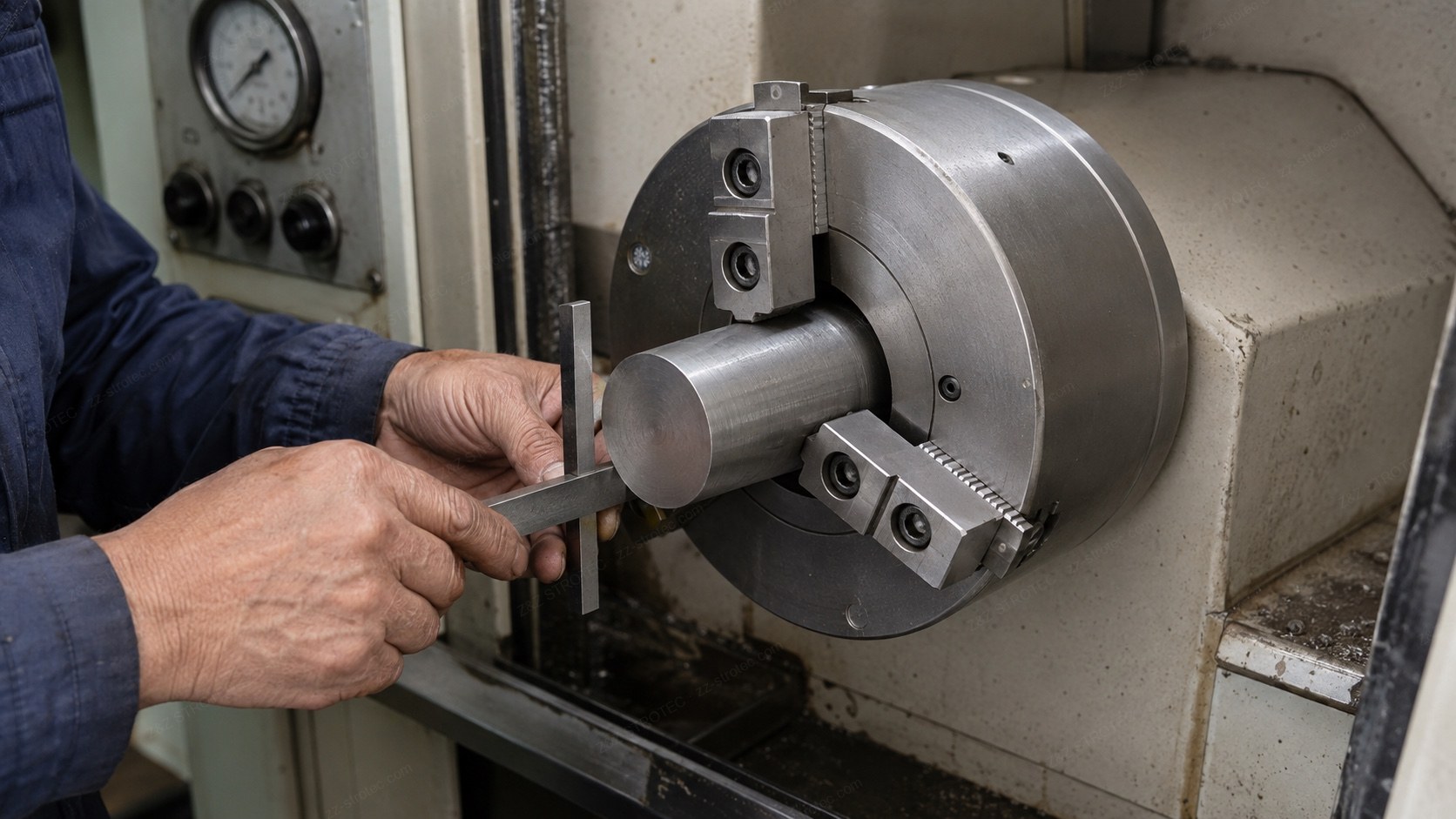
A part creeps in the jaws on a heavy facing cut, or it comes out with witness marks, and the first reaction on the shop floor is to raise the chuck pressure. The gauge reads pressure at the actuating cylinder. Between that gauge and the workpiece sit the draw tube, the chuck's lever ratio and mechanical efficiency, the jaws and their mass, where the jaws sit on the master jaw, how well the chuck has been greased, and the spindle speed at the moment of the cut. This article follows the calculation route published in a chuck maker's own technical manual, from cutting force to the initial clamping force you have to set, and lists what to check before touching the pressure. Values quoted below come from that manual's tables and worked example; your chuck's manual governs your chuck.
重車端面時工件在爪內位移,或是拆下來看到壓痕,現場第一個反應通常是把夾持壓力調高。但油壓表讀到的是油壓缸端的壓力,從那個表到工件之間,還隔著拉管、夾頭的槓桿比與機械效率、爪的重量、爪裝在母爪上的位置、夾頭潤滑狀況,以及切削當下的主軸轉速。本文依照夾頭原廠技術手冊公開的計算路徑,從切削力推到你實際要設定的初始夾持力,並整理調壓力之前該先查什麼。文中數值取自該手冊的表格與計算範例,實際仍以你手上夾頭的原廠手冊為準。
중절삭 단면 가공에서 공작물이 죠 안에서 밀리거나 자국이 남으면 현장에서는 먼저 척 압력을 올립니다. 그러나 게이지가 표시하는 것은 작동 실린더 쪽 압력입니다. 게이지와 공작물 사이에는 드로튜브, 척의 레버비와 기계 효율, 죠의 질량, 마스터 죠 위의 죠 위치, 그리스 상태, 그리고 절삭 시점의 주축 회전수가 있습니다. 이 글은 척 제조사 기술 매뉴얼에 공개된 계산 경로를 따라 절삭력에서 실제로 설정해야 할 초기 파지력까지 정리하고, 압력을 조정하기 전에 확인할 항목을 제시합니다. 인용 수치는 해당 매뉴얼의 표와 계산 예이며, 실제 적용은 보유 척의 매뉴얼을 따라야 합니다.
1. What the grip is actually resisting
1. 夾持力到底在對抗什麼
1. 파지력이 실제로 견디는 것
In turning, the main cutting force acts at the machining diameter and produces a moment about the clamping point. That moment has to be absorbed by friction between the jaw faces and the workpiece. The manual's first formula puts it as Fspz = (Fs × Sz ÷ µsp) × (dz ÷ dsp), where Fs is the main cutting force, Sz a length factor for the overhang, µsp the chucking coefficient (friction between jaw and workpiece) and dz ÷ dsp the ratio of machining diameter to chucking diameter. Feed force and radial force are comparatively small and are set aside for a first estimate. Two things follow immediately. Machining far out on a long part raises the required force through Sz, and gripping a small diameter while cutting a large one raises it through the diameter ratio. Neither is fixed by pressure alone. [1]
車削時,主切削力作用在加工直徑上,對夾持點形成一個力矩,這個力矩必須靠爪面與工件之間的摩擦來吸收。手冊的第一式寫成 Fspz=(Fs × Sz ÷ µsp)×(dz ÷ dsp):Fs 為主切削力,Sz 為與伸出長度有關的長度係數,µsp 為夾持係數(爪與工件間的摩擦),dz ÷ dsp 為加工直徑與夾持直徑之比。進給分力與徑向分力相對小,初估時可先略去。由此可以直接得到兩個結論:加工位置離夾持點越遠,Sz 越大、需要的夾持力越高;夾小徑車大徑,直徑比也會把需求推上去。這兩件事都不是單靠調壓力可以解決的。[1]
선삭에서 주절삭력은 가공 직경에 작용해 클램핑 지점에 대한 모멘트를 만들고, 이 모멘트는 죠면과 공작물 사이의 마찰로 흡수되어야 합니다. 매뉴얼의 첫 번째 식은 Fspz = (Fs × Sz ÷ µsp) × (dz ÷ dsp)입니다. Fs는 주절삭력, Sz는 돌출 길이에 대한 길이 계수, µsp는 파지 계수(죠와 공작물 사이 마찰), dz ÷ dsp는 가공 직경과 파지 직경의 비입니다. 이송 분력과 반경 방향 분력은 상대적으로 작아 초기 추정에서는 생략합니다. 여기서 두 가지가 바로 도출됩니다. 클램핑 지점에서 멀리 가공할수록 Sz가 커져 필요 파지력이 올라가고, 작은 직경을 물고 큰 직경을 절삭해도 직경비를 통해 올라갑니다. 둘 다 압력만으로 해결되지 않습니다. [1]
2. A worked example, taken from the manual
2. 依手冊範例算一次
2. 매뉴얼의 계산 예
The manual works a low alloy steel part on a 6 inch three jaw chuck with standard height pointed soft jaws, seated against a stop: chucking diameter 75 mm, machined diameter 50 mm, feed 0.20 mm/rev, depth of cut 2 mm, 50 mm between the start of the cut and the clamping point, 20 mm chucking length, 2,000 rpm. Main cutting force Fs = 0.20 × 2 × 3,400 = 1,360 N, with 3,400 N/mm² read from its specific cutting force table. Required gripping force Fspz = (1,360 × 2 ÷ 0.15) × 0.6666 = 12,077 N, with Sz = 2 and µsp = 0.15 from its tables. Those coefficients are the part of the calculation that travels least well: a different jaw form, a different material or a ground rather than as-cut surface changes µsp, and every maker publishes its own tables. Use the figures for the chuck in front of you. [1]
手冊的範例是低合金鋼工件,裝在 6 吋三爪夾頭上,使用標準高度的尖齒軟爪並抵住定位擋塊:夾持直徑 75 mm、加工直徑 50 mm、進給 0.20 mm/rev、切深 2 mm、切削起點到夾持點 50 mm、夾持長度 20 mm、轉速 2,000 rpm。主切削力 Fs=0.20 × 2 × 3,400=1,360 N,其中 3,400 N/mm² 取自該手冊的比切削力表。所需夾持力 Fspz=(1,360 × 2 ÷ 0.15)× 0.6666=12,077 N,其中 Sz=2、µsp=0.15 亦取自其表格。這些係數正是最不能直接搬用的部分:爪形不同、材質不同、工件表面是黑皮還是已加工面,µsp 就會變,而各家原廠公布的表也不一樣。請以你手上那顆夾頭的資料為準。[1]
매뉴얼의 예는 저합금강 공작물을 6인치 3죠 척에 표준 높이 소프트 죠로 물리고 스톱에 밀착시킨 조건입니다. 파지 직경 75 mm, 가공 직경 50 mm, 이송 0.20 mm/rev, 절삭 깊이 2 mm, 절삭 시작점과 클램핑 지점 사이 50 mm, 파지 길이 20 mm, 2,000 rpm입니다. 주절삭력 Fs = 0.20 × 2 × 3,400 = 1,360 N이며 3,400 N/mm²는 해당 매뉴얼의 비절삭력 표에서 읽은 값입니다. 필요 파지력 Fspz = (1,360 × 2 ÷ 0.15) × 0.6666 = 12,077 N이고 Sz = 2, µsp = 0.15도 같은 표에서 가져온 값입니다. 이 계수들이 가장 이전하기 어려운 부분입니다. 죠 형상, 재질, 흑피면인지 가공면인지에 따라 µsp가 달라지고 제조사마다 표가 다릅니다. 보유 척의 자료를 사용하십시오. [1]
3. Speed takes force away, so the static setting has to be higher
3. 轉速會把夾持力拿走,所以靜態要設得更高
3. 회전은 파지력을 줄이므로 정지 상태 설정값이 더 높아야 합니다
The jaws are masses on a rotating body. Centrifugal force pulls them outward, and on external gripping that pull works against the clamping direction. The manual states plainly that at high spindle speed these forces can reduce the gripping force of the chuck substantially, and sets the initial force as FspQ = Sz × (Fspz ± Fc), the plus sign applying to external gripping. In the same example the centrifugal force of the jaws at 2,000 rpm is read off its curve as 3,111 N, which is roughly a quarter of the 12,077 N the cut required. The practical consequence is the one that gets missed: a static grip measured at zero rpm is not the grip you have during the cut, the shortfall grows with speed, and it grows faster with heavier jaws. The curves in that manual are drawn for standard height pointed soft blank jaws at the mid position of the master jaw, and it states that separate centrifugal calculations must be made when special heavy top jaws are used. [1]
爪是旋轉體上的質量。離心力把爪往外拉,外夾時這個方向正好與夾持方向相反。手冊直接指出,主軸高轉速下這些力可以大幅降低夾頭的夾持力,並把初始夾持力寫成 FspQ=Sz ×(Fspz ± Fc),外夾取正號。同一範例中,2,000 rpm 時爪的離心力由曲線查得為 3,111 N,約為該次切削所需 12,077 N 的四分之一。實務上最常被忽略的就是這一點:靜止時量到的夾持力,不等於切削當下的夾持力,轉速越高差距越大,爪越重差距擴大得越快。該手冊的曲線是以標準高度尖齒軟爪、位於母爪中間位置為前提繪製,並註明使用特殊重型爪時必須另行計算離心力。[1]
죠는 회전체 위의 질량입니다. 원심력이 죠를 바깥으로 당기며, 외경 파지에서는 그 방향이 클램핑 방향과 반대입니다. 매뉴얼은 고속 회전에서 이 힘이 척의 파지력을 상당히 감소시킬 수 있다고 명시하고, 초기 파지력을 FspQ = Sz × (Fspz ± Fc)로 두며 외경 파지에는 더하기 부호를 적용합니다. 같은 예에서 2,000 rpm의 죠 원심력은 곡선에서 3,111 N으로 읽히며, 이는 절삭에 필요한 12,077 N의 약 4분의 1입니다. 실무에서 가장 자주 놓치는 점이 이것입니다. 정지 상태에서 측정한 파지력은 절삭 중 파지력이 아니며, 차이는 회전수와 함께 커지고 죠가 무거울수록 더 빨리 커집니다. 해당 곡선은 표준 높이 소프트 죠가 마스터 죠 중간 위치에 있을 때를 전제로 하며, 특수 중량 죠를 쓰면 원심력을 별도로 계산해야 한다고 적혀 있습니다. [1]
4. Three things you can change without spending anything
4. 三件不用花錢就能改的事
4. 비용 없이 바꿀 수 있는 세 가지
Jaw mass first. In the manual's charts the hard jaw loses the least force because it carries the least mass, the medium height jaw loses the most of the styles charted, and it advises that jaws higher or more massive than those should be avoided. A tall soft jaw bored for convenience is paid for at every rpm. Jaw position second. Its centrifugal curves assume the master jaw at mid position, and it describes that mid position as the best position to use any top jaw, with force loss charted separately against jaw location. Part support third. The length factor should not be less than 2 for normal unsupported turning; where the workpiece length to diameter ratio exceeds 3 it calls a tailstock or steady rest good practice, and with that support the factor can come down to 1. A step in the jaws or a work stop against the chuck face allows a 30% reduction, provided the operator makes certain the part is firmly seated when the chuck closes. Heavy facing and heavy OD forming cuts go the other way, at least 50% up. Halving the required force by supporting the part is a larger move than any pressure adjustment. [1]
第一是爪的質量。手冊的圖表中,硬爪因質量最小,夾持力損失最少;所列樣式中以中高型爪損失最大,並建議避免使用比它更高或更重的爪。為了方便而做得很高的軟爪,是每一轉都在付代價。第二是爪的位置。其離心力曲線以母爪位於中間位置為前提,並將中間位置描述為任何上爪都適用的最佳位置,另有一組圖表專門呈現夾持位置造成的力量損失。第三是工件支撐。一般無支撐車削時,長度係數不應小於 2;當工件長徑比大於 3,手冊將使用尾座或中心架列為良好作法,有支撐時係數可降到 1。爪上做階梯或在夾頭端面加定位擋塊,可再減 30%,前提是關夾頭時操作者確認工件確實貼靠。重車端面與重外徑成形車削則相反,至少要增加 50%。用支撐把需求夾持力減半,效果比任何壓力微調都大。[1]
첫째는 죠의 질량입니다. 매뉴얼의 도표에서 하드 죠는 질량이 가장 작아 손실이 가장 적고, 도표에 실린 형식 중에서는 중간 높이 죠의 손실이 가장 크며, 그보다 높거나 무거운 죠는 피하라고 권고합니다. 편의를 위해 높게 만든 소프트 죠는 회전할 때마다 대가를 치릅니다. 둘째는 죠 위치입니다. 원심력 곡선은 마스터 죠 중간 위치를 전제로 하며, 매뉴얼은 이 중간 위치를 어떤 톱 죠에도 가장 좋은 위치로 설명하고 위치에 따른 손실을 별도 도표로 제시합니다. 셋째는 공작물 지지입니다. 무지지 선삭에서 길이 계수는 2 미만이어서는 안 되며, 길이 대 직경비가 3을 넘으면 심압대나 방진구 사용을 권장하고 지지가 있으면 계수를 1까지 낮출 수 있습니다. 죠의 단차나 척 단면의 워크 스톱이 있으면 30% 감소가 가능하되, 척을 닫을 때 공작물이 확실히 밀착되었음을 확인해야 합니다. 중절삭 단면 가공과 중외경 성형 절삭은 반대로 최소 50% 증가입니다. 지지로 필요 파지력을 절반으로 줄이는 편이 어떤 압력 조정보다 큰 효과를 냅니다. [1]
5. A dry chuck loses force standing still
5. 沒有潤滑的夾頭,靜止時就已經在掉夾持力
5. 윤활이 끊긴 척은 정지 상태에서도 파지력을 잃습니다
The same draw bar force does not give the same grip on every chuck. Friction inside the wedge or lever mechanism eats part of it, and that internal friction is a maintenance variable, not a constant. The manual asks for the chuck to be greased a minimum of once every 24 hours, and more frequently with non-water based coolants or when very short cycle times are being run, and its own length factor table separates older chucks from new chucks properly serviced. Which is to say the maker expects the same calculation to land differently on a worn machine. This is why a static gripping force gauge is worth having on the shelf: it measures what the chuck now delivers, and it turns a maintenance argument into a number. Measure after re-jawing, after a coolant change and when a job that used to run starts slipping. [1]
同樣的拉桿拉力,在不同夾頭上不會得到同樣的夾持力。楔形或槓桿機構內部的摩擦會吃掉一部分,而這個內摩擦是保養變數,不是常數。手冊要求夾頭至少每 24 小時加注一次潤滑脂,使用非水性切削液或節拍時間很短時要更頻繁;其長度係數表本身也把「舊夾頭」與「保養良好的新夾頭」分開列。也就是說,原廠本來就預期同一套計算在老舊機台上會落在不同位置。這正是值得備一支靜態夾持力計的原因:它量的是夾頭現在能給出多少,把保養爭議變成一個數字。重新配爪之後、換切削液之後,以及本來跑得好好的工件開始打滑時,都該量一次。[1]
같은 드로바 힘이라도 척마다 같은 파지력이 나오지 않습니다. 웨지나 레버 기구 내부 마찰이 일부를 소모하며, 이 내부 마찰은 상수가 아니라 정비 변수입니다. 매뉴얼은 최소 24시간마다 그리스 주입을 요구하고, 비수용성 절삭유를 쓰거나 사이클 타임이 매우 짧으면 더 자주 하라고 합니다. 길이 계수 표도 노후 척과 정상 정비된 신품 척을 구분합니다. 제조사 스스로 동일한 계산이 노후 장비에서 다르게 나온다고 보는 것입니다. 정적 파지력 게이지를 갖출 이유가 여기 있습니다. 지금 척이 내는 값을 측정해 정비 논쟁을 수치로 바꿔 줍니다. 죠 재가공 후, 절삭유 교체 후, 잘 돌던 작업이 미끄러지기 시작할 때 측정하십시오. [1]
6. The limits that are not open to adjustment
6. 不能調整的界線
6. 조정 대상이 아닌 한계
Raising pressure to hold a part is bounded by the chuck, the cylinder and the machine, and those bounds are safety items. The manual's checklist for the machine is explicit: the spindle must not be able to rotate before clamping pressure has built up and clamping has taken place; the chuck must not open until the spindle has come to a complete stop; the workpiece must stay firmly gripped through a hydraulic, pneumatic or electrical power failure; a pressure failure at the cylinder must signal the spindle to stop; and the machine must have a speed limiting device so that spindle rpm cannot exceed the chuck's maximum. It also warns that a chuck which has been modified or repaired should not be used until precision balanced by a qualified technician, and that out of balance forces from unbalanced workpieces or special shaped jaws are not covered by the length factor tables at all. For the standards behind this, ISO 16156:2004 covers safety requirements for the design and construction of work holding chucks. Manuals still in circulation, including this one, point the user at ISO/TR 13618, and ISO lists that technical report as withdrawn, so treat it as a legacy reference and work from the edition in force together with your machine builder's manual. [2] [3]
用調高壓力來夾住工件,受到夾頭、油壓缸與機台三者的限制,而這些限制屬於安全項目。手冊對機台的檢查清單寫得很明確:夾持壓力尚未建立、夾持尚未完成之前,主軸不得旋轉;主軸完全停止之前,夾頭不得鬆開;油壓、氣壓或電力中斷時,工件必須維持確實夾持;油壓缸端壓力失效時,必須發出訊號讓主軸停止;機台必須具備轉速限制裝置,使主軸轉速不會超過夾頭的最高轉速。手冊另外警告,經改造或維修過的夾頭,未經合格技師精密平衡前不應使用;而不平衡工件或特殊形狀爪所產生的不平衡力,長度係數表根本沒有涵蓋。相關標準方面,ISO 16156:2004 規範工件夾頭設計與製造的安全要求。目前仍在流通的手冊(包含本文引用的這一本)會指向 ISO/TR 13618,而 ISO 已將該技術報告列為作廢,因此請把它當成歷史文獻,實際依現行版本與機台原廠手冊執行。[2] [3]
압력을 올려 공작물을 잡는 방법은 척, 실린더, 장비의 한계 안에서만 가능하며 이 한계는 안전 항목입니다. 매뉴얼의 장비 점검 목록은 명확합니다. 클램핑 압력이 형성되고 클램핑이 완료되기 전에는 주축이 회전해서는 안 되고, 주축이 완전히 정지하기 전에는 척이 열려서는 안 되며, 유압·공압·전원이 끊겨도 공작물은 확실히 파지되어야 하고, 실린더 압력 이상 시 주축 정지 신호가 나가야 하며, 주축 회전수가 척의 최고 회전수를 넘지 못하도록 속도 제한 장치가 있어야 합니다. 또한 개조하거나 수리한 척은 자격을 갖춘 기술자가 정밀 밸런싱하기 전에는 사용하지 말라고 경고하며, 불평형 공작물이나 특수 형상 죠에서 생기는 불평형력은 길이 계수 표에 전혀 포함되어 있지 않다고 밝힙니다. 표준으로는 ISO 16156:2004이 공작물 척의 설계·제조 안전 요구사항을 다룹니다. 아직 유통 중인 매뉴얼들은 ISO/TR 13618을 인용하지만 ISO는 이 기술보고서를 폐지 상태로 표시하므로, 참고 자료로만 보고 현행판과 장비 제조사 매뉴얼을 기준으로 하십시오. [2] [3]
7. It still slips or marks: what to check, in order
7. 還是打滑或壓傷:檢查順序
7. 그래도 미끄러지거나 자국이 남을 때 확인 순서
Run the same job at a lower spindle speed with everything else held; if the slipping stops, the problem is force lost at speed and belongs in sections 3 and 4, not in the pressure valve. Check that soft jaws were bored at the working pressure and on the diameter actually used, so contact is on the full face rather than at two lines. Clear chips from the serrations and the master jaw, and confirm the jaw bolts are the specified grade and torque, seated on the correct serration pitch. Confirm the draw bar stroke is inside its limits with the part in place, because a chuck at the end of stroke reads pressure without producing grip. Compare the cylinder pressure against the chuck's rated maximum draw bar pull rather than the cylinder's own maximum. If the marks are the complaint rather than the slipping, the answer is usually more contact area or a softer jaw material at the same force, not less force, and on thin walls the deformation route matters more than the grip route. [4]
先在其他條件不變下,用較低轉速跑同一支工件;如果不再打滑,問題就是轉速造成的夾持力流失,該回到第 3、4 節處理,而不是去動壓力閥。接著確認軟爪是在工作壓力下、依實際使用直徑鏜出,接觸面才會是整個面而不是兩條線。清除齒面與母爪上的切屑,確認爪螺栓的等級與鎖付扭力符合規定,且座落在正確的齒距上。裝上工件後確認拉桿行程仍在範圍內,因為行程到底的夾頭壓力照樣有讀值,卻沒有夾持力。油壓缸壓力要對照夾頭額定的最大拉力,而不是油壓缸本身的最大值。如果問題是壓痕而不是打滑,通常的解法是在相同夾持力下增加接觸面積或改用較軟的爪材,而不是降低夾持力;薄壁件則要走變形的路線來看,而非夾持力的路線。[4]
다른 조건을 고정한 채 회전수만 낮춰 같은 작업을 돌려 보십시오. 미끄러짐이 멈추면 원인은 회전에 따른 파지력 손실이며 3·4절의 문제이지 압력 밸브의 문제가 아닙니다. 소프트 죠가 작업 압력에서 실제 사용 직경으로 보링되었는지 확인하십시오. 그래야 두 줄이 아니라 전체 면으로 접촉합니다. 세레이션과 마스터 죠의 칩을 제거하고, 죠 볼트의 등급과 체결 토크가 규정에 맞으며 올바른 세레이션 피치에 안착했는지 확인하십시오. 공작물을 물린 상태에서 드로바 행정이 한계 안에 있는지 확인하십시오. 행정 끝에 도달한 척은 압력은 표시되지만 파지력은 나오지 않습니다. 실린더 압력은 실린더 자체 최대값이 아니라 척의 정격 최대 드로바 인장력과 비교해야 합니다. 문제가 미끄러짐이 아니라 자국이라면 해법은 대개 같은 힘에서 접촉 면적을 늘리거나 더 연한 죠 재질을 쓰는 것이지 힘을 줄이는 것이 아니며, 얇은 부품은 파지력보다 변형 관점에서 접근해야 합니다. [4]
Before you change the pressure, record this / 調壓力之前,先記下這些 / 압력 변경 전 기록 항목
| Item / 項目 / 항목 | Record / 紀錄 / 기록 |
|---|---|
| Chuck make, model, size, spindle nose / 夾頭品牌、型號、尺寸、主軸鼻端 / 척 제조사·모델·치수·주축 노즈 | — |
| Maximum rpm marked on the chuck / 夾頭標示的最高轉速 / 척에 표시된 최고 회전수 | — |
| Jaw type, height, position on master jaw / 爪型式、爪高、在母爪上的位置 / 죠 종류·높이·마스터 죠 위치 | — |
| Cylinder pressure and draw bar force / 油壓缸壓力與拉桿拉力 / 실린더 압력과 드로바 인장력 | — |
| Measured static gripping force, and date / 實測靜態夾持力與量測日期 / 측정한 정적 파지력과 측정일 | — |
| Working rpm at the cut that fails / 出問題那一刀的實際轉速 / 문제가 생기는 절삭의 실제 회전수 | — |
| Material, chucking diameter, machined diameter, chucking length, overhang / 材質、夾持直徑、加工直徑、夾持長度、伸出長度 / 재질·파지 직경·가공 직경·파지 길이·돌출 길이 | — |
| Feed, depth of cut, tailstock or steady rest in use / 進給、切深、是否使用尾座或中心架 / 이송·절삭 깊이·심압대 또는 방진구 사용 여부 | — |
| Last greasing, coolant type, cycle time / 上次加注潤滑脂時間、切削液種類、節拍時間 / 최종 그리스 주입 시점·절삭유 종류·사이클 타임 | — |
References / 參考資料 / 참고자료
- Hardinge — Sure-Grip Power Chuck Safety and Technical Manual B-87Z (gripping force formulas, centrifugal force curves, jaw height and position charts, lubrication)
- ISO 16156:2004 — Machine-tools safety, safety requirements for the design and construction of work holding chucks
- ISO/TR 13618:1993 — Code of practice for the safe operation of work-holding chucks used on lathes (listed by ISO as withdrawn)
- Kitagawa — PUB chuck instruction manual (excessive gripping force as a cause of workpiece deformation)
Sources checked 2026-09-03. The formulas, coefficients and example values are those published by the cited manufacturers for their own products; they are reproduced here to show the method, not as specifications for any other chuck. Setting clamping force, verifying it and working within the machine's limits are the responsibility of the machine owner and the qualified personnel operating it.
資料查核:2026-09-03。文中公式、係數與範例數值,是各原廠針對自家產品公布的內容,此處引用是為了說明方法,不能當成其他夾頭的規格。夾持力的設定、驗證,以及是否在機台限制內運轉,屬於機台所有人與現場合格人員的責任。
자료 확인: 2026-09-03. 본문의 수식·계수·예시 값은 각 제조사가 자사 제품에 대해 공개한 자료이며, 방법을 보여주기 위해 인용한 것이지 다른 척의 사양이 아닙니다. 파지력 설정과 검증, 장비 한계 내 운전은 장비 소유자와 현장 자격자의 책임입니다.
Send the chuck plate and the part / 給我們夾頭銘牌與工件 / 척 명판과 공작물 정보를 보내주세요
Chucks, soft and hard jaws, collets and jaw bolts are items we quote and ship. Send a photograph of the chuck body marking with its maximum rpm, the spindle nose designation, the master jaw serration pitch and count, and the part diameter and material, and we will come back on what is available and the lead time. The actuating cylinder, the draw tube and the machine's speed limit have to be confirmed against your machine builder's data, and we will say so where that is the blocker rather than quote around it. Parts are normally quoted EXW. Fitting, gripping force verification and commissioning are done on your machine by qualified personnel, so tell us the country and we will confirm the scope case by case.
장비 모델명, 부품 번호 또는 현장 사진을 보내주시면 공급 가능 여부와 가격을 회신드립니다.
Multi-brand selection rather than one factory, spec and compatibility checks in writing, a test cut and inspection at the plant before the machine ships, export documentation, and the same part number still available years later. Installation and after-sales in Korea, Brazil, Switzerland and Argentina run through local agents; for other markets we supply parts and components.
不綁單一工廠的多品牌選型、白紙黑字的規格與相容性確認、出貨前在工廠端試車驗機、出口文件,以及數年後仍拿得到的同一料號。韓國、巴西、瑞士、阿根廷的安裝與售後由在地服務商執行,其他市場我們供應零件與零組件。
단일 공장에 묶이지 않는 다중 브랜드 선정, 문서로 남기는 사양·호환성 확인, 선적 전 공장 시운전과 검사, 수출 서류, 그리고 수년 뒤에도 확보 가능한 동일 품번. 한국·브라질·스위스·아르헨티나의 설치와 애프터서비스는 현지 대리점이 담당하며, 그 외 시장에는 부품을 공급합니다.