 Z&Z STROTEC
CNC Lathe Specification Guide
CNC 車床規格指南 · CNC 선반 사양 가이드
View interactive version · 完整互動版 · 인터랙티브 버전 →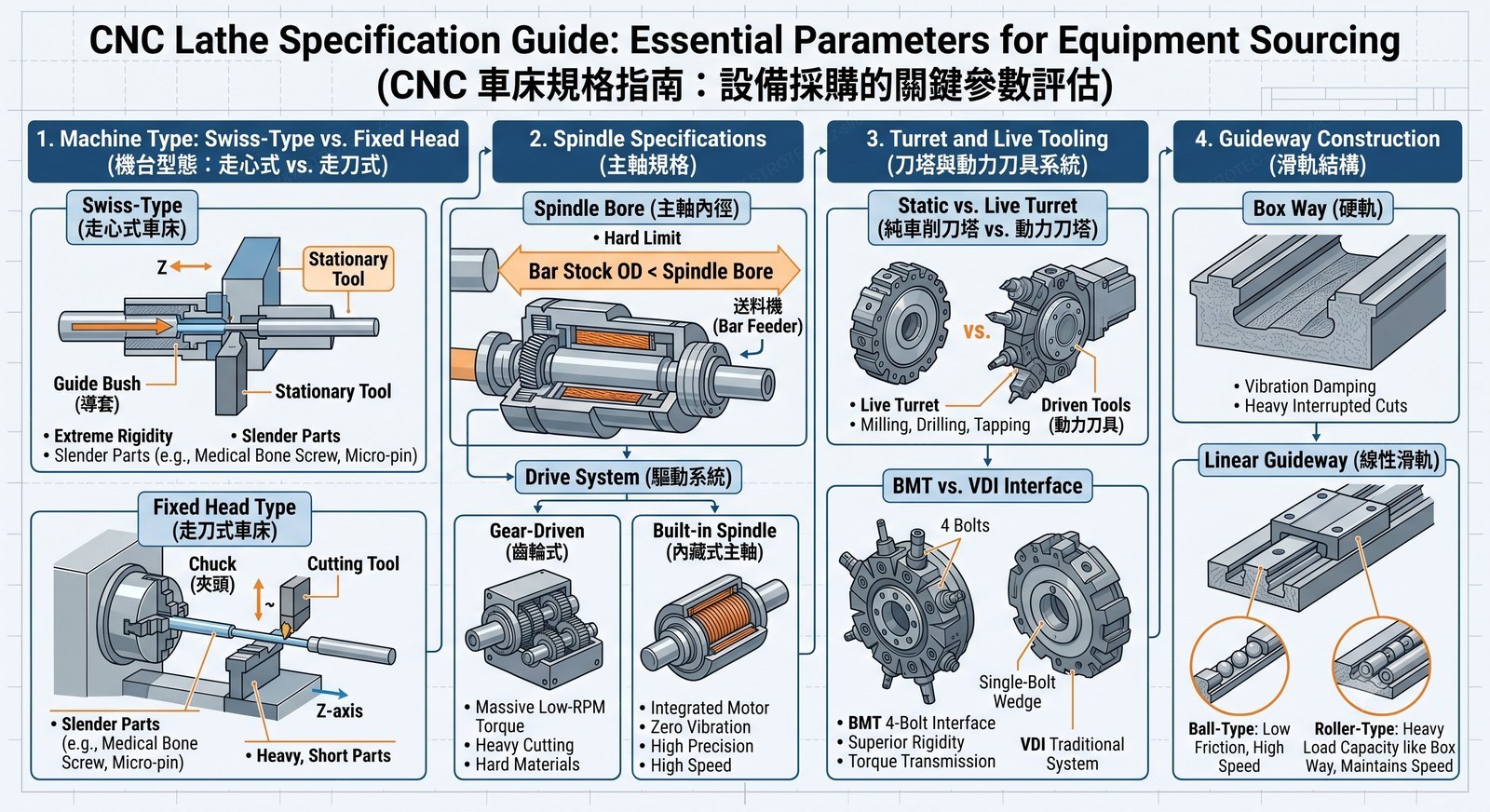
CNC lathe specifications: machine types & selection guide overview
Machine Type: Swiss-Type vs. Fixed Head
- Swiss-type (走心式, sliding headstock): Bar stock passes through a guide bush and is supported right next to the cutting point, giving excellent rigidity — ideal for long, slender parts such as medical bone screws and micro pins.
- Fixed head (走刀式): The bar is clamped in a chuck and the cutting tool moves along the Z-axis. The industry standard for shorter, larger-diameter parts.
Key Specifications to Evaluate
- Swing over bed (最大車削直徑): Maximum workpiece diameter that fits over the machine bed
- Max turning length: Maximum length of workpiece between centers
- Bar capacity / spindle bore (主軸孔徑): Maximum bar diameter that passes through the spindle — critical for bar feeder compatibility
- Spindle speed range (RPM): Higher RPM = better for small diameter, high-speed cutting
- Spindle motor power (kW): More power = heavier cuts possible
- Number of turret stations: 8, 10, or 12 stations typical
- Live tooling (動力刀具): Whether the turret supports rotating tools for milling/drilling operations
- Sub-spindle (副主軸): Second spindle for backside operations without reclamping
- C-axis: Spindle can be used as a controlled axis for contouring with live tools
- Y-axis: Off-center machining capability
Guideway Construction: Box Way vs. Linear Guideway
- Box way (硬軌): Sliding ways cast into the machine bed and finished by grinding/hand scraping. The large contact area gives excellent vibration damping for heavy and interrupted cuts, at the cost of slower rapid traverse.
- Linear guideway (線軌): Fast rapid traverse and low friction. Roller-type linear guides offer higher load capacity and rigidity than ball-type, narrowing the gap with box ways while keeping the speed advantage — now widely adopted.
CNC Controller Options
- FANUC: Most widely used globally. Strong service network.
- SYNTEC (新代): Taiwan-made. Cost-effective. Growing market share.
- Mitsubishi M-series: Common in Japanese-influenced markets.
- Siemens 828D/840D: Preferred in European markets.
Taiwan's Strengths: Competitiveness Beyond Price
A stronger New Taiwan Dollar has pushed up Taiwan's export quotations, while a weaker Japanese yen has made Japanese machines more price-attractive and Chinese builders keep competing aggressively on price. Taiwan's edge on price alone is therefore no longer as decisive as it once was.
Taiwan's real competitiveness lies beyond price: consistent build quality and process capability; a mid-to-high-tier international position between Japan's premium segment and China's low-cost segment, striking the best balance of performance and cost; and mature export experience backed by strong after-sales support — fast technical service, spare-parts availability, and a wide distributor network that lower a buyer's total cost of ownership (TCO) and downtime risk. For buyers who value stable long-term production, this is where Taiwan-made machines remain most compelling.
Upgrading to Mill-Turn CNC Lathes: Is the "Done-in-One" Approach Worth It?
Add a Y-axis and a sub-spindle and a single lathe can finish milling, drilling, and the back side in one setup — but it demands a higher capital cost and more advanced CAD/CAM. The column weighs when mill-turn pays off and when a dedicated lathe is still the more economical choice.
Every time a part is unclamped and moved to another machine, concentricity is lost. Completing all features in one setup holds tolerances that would otherwise drift between machines.
Paired with a bar feeder or gantry loader, a mill-turn lathe can run unattended around the clock, sharply reducing labor cost.
CNC 車床規格:機台型態與選型指南總覽
機台型態:走心式 vs. 走刀式
- 走心式(Swiss-type,移動主軸):棒料穿過導套,在切削點附近獲得支撐,剛性極佳,適合醫療骨釘、微型銷等細長零件。
- 走刀式(固定主軸):棒料由夾頭夾持,由刀具沿 Z 軸移動進行切削,是較粗短零件的業界標準機型。
關鍵規格說明
- 最大車削直徑(Swing over bed):工件可通過機台床身的最大直徑
- 最大車削長度:兩頂尖間可加工的最大工件長度
- 棒料容量 / 主軸孔徑:可穿過主軸的最大棒料直徑 — 與料機相容性的關鍵
- 主軸轉速範圍(RPM):轉速越高,越適合小直徑、高速切削
- 主軸馬達功率(kW):功率越大,可進行越重的切削
- 刀塔站數:通常為 8、10 或 12 站
- 動力刀具:刀塔是否支援旋轉刀具進行銑削/鑽孔
- 副主軸:第二主軸,可在不重新夾持的情況下進行背面加工
- C 軸:主軸可作為受控軸,搭配動力刀具進行輪廓加工
- Y 軸:偏心加工能力
滑軌結構:硬軌 vs. 線性滑軌
- 硬軌(Box Way):滑動面直接鑄造於床身並經研磨/鏟花加工,接觸面積大、減震性佳,適合重切削與斷續切削,但快速位移速度較慢。
- 線性滑軌(Linear Guideway):快速位移速度高、摩擦低;滾柱式線軌的承載能力與剛性優於滾珠式,在保有線軌速度優勢的同時縮小與硬軌的剛性差距,現已被廣泛採用。
CNC 控制器選項
- FANUC:全球最廣泛使用,服務網絡完善。
- SYNTEC 新代(台灣):台灣製造,具成本競爭力,市占率持續成長。
- Mitsubishi M 系列:常見於日系品牌機台。
- Siemens 828D/840D:歐洲市場偏好。
台灣工具機的優勢:價格之外的競爭力
近年新台幣匯率走強,使台灣機台的出口報價相對提高;加上日圓貶值讓日本機台更具價格吸引力、中國機台以低價策略搶市,台灣工具機在「價格面」的優勢已不如以往明顯。
但台灣的真正競爭力在價格之外:穩定一致的整機品質與製程水準、介於日系高階與中國低價之間的中高階國際定位(在性能與成本間取得最佳平衡),以及成熟的出口經驗與完善的售後服務——快速的技術支援、零備件供應與遍及各地的經銷網絡,能有效降低客戶的總持有成本(TCO)與停機風險。對重視長期穩定生產的買家而言,這才是台灣機台最具說服力的價值所在。
升級車銑複合機:「一次裝夾加工完成」的策略值得投資嗎?
加裝 Y 軸與副主軸後,一台車床即可在「一次裝夾」中完成銑削、鑽孔乃至背面加工——但也需要較高的初期投資與 CAD/CAM 程式能力。專欄剖析車銑複合何時划算、何時專用車床仍是較經濟的選擇。
工件每經一次拆卸並移至另一台機器便會損失同心度。在單次裝夾中完成所有特徵,可守住跨機台加工原本會偏移的公差。
搭配送料機或門式機械手,車銑複合機可全天候無人運轉,大幅節省人力成本。
CNC 선반 사양: 기계 유형 및 선정 가이드 개요
기계 유형: 스위스형 vs. 고정주축형
- 스위스형 (주축 이동형, 走心式): 봉재가 가이드 부시를 통과하며 절삭점 바로 옆에서 지지되어 높은 강성을 확보. 의료용 본 스크류나 마이크로 핀 같은 가늘고 긴 부품 가공에 적합.
- 고정주축형 (走刀式): 소재를 척으로 클램핑하고 공구가 Z축을 따라 이동. 비교적 짧고 직경이 큰 부품 가공의 업계 표준.
평가해야 할 주요 사양
- 베드 위 스윙 (최대 선삭 직경): 기계 베드 위에 들어가는 최대 공작물 직경
- 최대 선삭 길이: 두 센터 사이의 최대 공작물 길이
- 봉재 용량 / 주축 내경: 주축을 통과할 수 있는 최대 봉재 직경 — 바피더 호환성의 핵심
- 주축 회전수 범위 (RPM): 높을수록 소직경 고속 절삭에 유리
- 주축 모터 출력 (kW): 출력이 클수록 중절삭 가능
- 터렛 스테이션 수: 통상 8, 10, 12스테이션
- 동력 공구 (Live tooling): 터렛에서 밀링/드릴링을 위한 회전 공구 지원 여부
- 보조 주축 (Sub-spindle): 재클램프 없이 배면 가공을 위한 제2 주축
- C축: 동력 공구를 사용한 윤곽 가공을 위한 제어 축으로서의 주축
- Y축: 편심 가공 능력
안내면 구조: 박스 웨이 vs. 리니어 가이드
- 박스 웨이 (硬軌): 머신 베드에 주조 후 연삭·스크래핑 가공된 미끄럼 안내면. 접촉 면적이 넓어 진동 감쇠가 우수하며 중절삭·단속 절삭에 유리하나, 급속 이송 속도는 느림.
- 리니어 가이드 (線軌): 빠른 급속 이송과 낮은 마찰이 장점. 롤러 타입 리니어 가이드는 볼 타입보다 부하 용량과 강성이 높아, 속도 이점을 유지하면서 박스 웨이와의 강성 격차를 줄여 널리 채택되고 있음.
CNC 컨트롤러 옵션
- FANUC: 전 세계적으로 가장 많이 사용. 강력한 서비스 네트워크.
- SYNTEC (新代): 대만 제조. 비용 경쟁력. 시장 점유율 증가 중.
- Mitsubishi M 시리즈: 일본계 브랜드에서 일반적.
- Siemens 828D/840D: 유럽 시장에서 선호.
대만 공작기계의 강점: 가격을 넘어선 경쟁력
최근 대만 달러(TWD) 강세로 대만 기계의 수출 견적이 상대적으로 높아졌고, 엔저로 일본 기계의 가격 매력이 커졌으며, 중국 기계는 저가 전략으로 시장을 공략하고 있습니다. 그 결과 '가격' 측면에서 대만의 우위는 예전만큼 결정적이지 않습니다.
그러나 대만의 진정한 경쟁력은 가격 너머에 있습니다: 안정적이고 일관된 완성도와 공정 수준, 일본의 프리미엄과 중국의 저가 사이에 위치한 중·고급 국제 포지셔닝(성능과 비용의 최적 균형), 그리고 성숙한 수출 경험과 충실한 애프터서비스 — 신속한 기술 지원, 예비 부품 공급, 폭넓은 대리점 네트워크가 고객의 총소유비용(TCO)과 가동 중단 리스크를 낮춥니다. 장기적이고 안정적인 생산을 중시하는 바이어에게 이것이야말로 대만산 기계의 가장 설득력 있는 가치입니다.
복합가공기(Mill-Turn)로의 업그레이드: '원셋업' 전략은 투자할 가치가 있는가?
Y축과 보조 주축을 더하면 선반 한 대에서 밀링·드릴링·배면 가공까지 '원셋업'으로 완료할 수 있습니다 — 다만 더 높은 초기 투자와 CAD/CAM 역량이 필요합니다. 복합가공이 언제 수지가 맞고, 언제 전용 선반이 더 경제적인지 짚어봅니다.
공작물을 분리해 다른 기계로 옮길 때마다 동심도가 손실됩니다. 단일 셋업에서 모든 형상을 완성하면 기계 간에 벌어질 공차를 잡아둘 수 있습니다.
바피더나 갠트리 로더와 결합하면 복합가공기는 24시간 무인 운전이 가능하여 인건비를 크게 절감합니다.
장비 모델명, 부품 번호 또는 현장 사진을 보내주시면 공급 가능 여부와 가격을 회신드립니다.
Multi-brand selection rather than one factory, spec and compatibility checks in writing, a test cut and inspection at the plant before the machine ships, export documentation, and the same part number still available years later. Installation and after-sales in Korea, Brazil, Switzerland and Argentina run through local agents; for other markets we supply parts and components.
不綁單一工廠的多品牌選型、白紙黑字的規格與相容性確認、出貨前在工廠端試車驗機、出口文件,以及數年後仍拿得到的同一料號。韓國、巴西、瑞士、阿根廷的安裝與售後由在地服務商執行,其他市場我們供應零件與零組件。
단일 공장에 묶이지 않는 다중 브랜드 선정, 문서로 남기는 사양·호환성 확인, 선적 전 공장 시운전과 검사, 수출 서류, 그리고 수년 뒤에도 확보 가능한 동일 품번. 한국·브라질·스위스·아르헨티나의 설치와 애프터서비스는 현지 대리점이 담당하며, 그 외 시장에는 부품을 공급합니다.